










Ultimate Guide to Robotic Welding Stations: Types, Key Components, and ROI
2026-09-21

Target Keyword: robotic welding station
Manual welding faces unprecedented challenges: rising labor costs, severe welder shortages, and strict quality control demands. A robotic welding station (also referred to as a robotic welding cell) has shifted from an advanced luxury to an essential automated solution for high-precision metal fabrication.
Whether you are looking to scale high-volume automotive production or need a flexible automated setup for low-volume, high-mix jobs, this guide covers everything you need to know about robotic welding stations—including system architecture, types, cost benefits, and how to choose the right configuration.
What is a Robotic Welding Station?
A robotic welding station is an integrated, automated system where a industrial robot arm or collaborative robot (cobot) performs welding tasks with high repeatability, speed, and precision.
Unlike standalone welding machines, a complete robotic welding station combines motion control, power management, part positioning, safety enclosures, and fume extraction into a single synchronized unit.
7 Essential Components of an Automated Robotic Welding Station
To ensure continuous 24/7 operation and consistent weld seams, a modern robotic welding cell relies on seven core integrated subsystems:
Component | Function / Subsystem Details |
1. Robotic Arm | 6-axis articulated robot or 6-axis cobot providing flexible reach and precise positioning. |
2. Welding Power Source & Torch | Delivers digital arc control for MIG, TIG, Laser, or Spot welding processes. |
3. Wire Feeder & Conduit | Ensures smooth, steady filler metal delivery during continuous seam welding. |
4. Workpiece Positioner / Table | Rotates or tilts parts (e.g., 2-axis positioner or H-frame) so welds are always performed in the flat position. |
5. Torch Cleaning & Service Station | Automatic reamer, anti-spatter sprayer, and wire cutter to prevent nozzle buildup and maintenance downtime. |
6. Safety Enclosure & Fume Extraction | Light curtains, interlocking safety doors, dark glass panels, and high-efficiency fume extraction systems. |
7. Central Controller & PLC | Manages safety interlocks, robot trajectories, and welding parameters via a user-friendly HMI/Teach Pendant. |
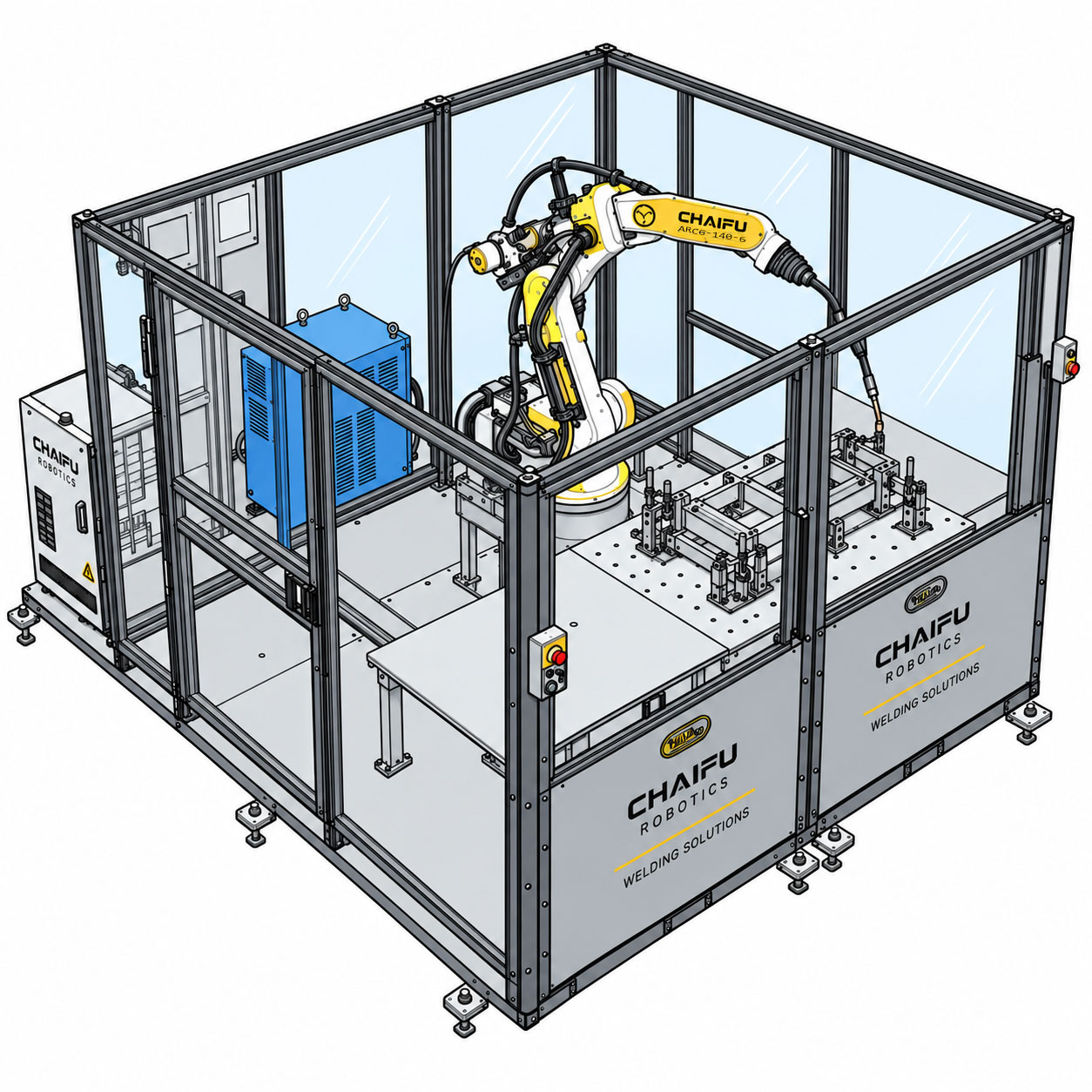
Industrial Robotic Welding Cell vs.
Choosing between a high-speed industrial robotic welding cell and a compact cobot welding station depends heavily on your production volume, part mix, and floor space restrictions.
+---------------------------------------+ | Which Welding Station Do You Need? | +---------------------------------------+ | +---------------------+ ---------------------+ | | [ High Volume / Heavy Parts ] [ Small Batches / High-Mix ] | | v v +------------------------------+ +------------------------------+ | Industrial Welding Station | | Cobot Welding Station | | - High Speed & High Payload | | - Rapid Deployment | | - Full Safety Cage / Fencing | | - Footprint-saving / No Cage | | - Dedicated Fixtures | | - Lead-Through Teaching | +------------------------------+ +------------------------------+
1. Industrial Robotic Welding Cells
Best For:
High-volume, continuous production (e.g., Automotive frames, heavy equipment). Advantages:
Ultra-high travel speed, long reach, higher payload capacity, exceptional duty cycle. Considerations:
Requires physical safety fencing, light curtains, and specialized robot programmers.
2. Collaborative (Cobot) Welding Workstations
Best For:
Small-to-medium enterprises (SMEs), high-mix/low-volume job shops. Advantages:
Quick setup, compact footprint, hand-guided "lead-through" teaching, can operate alongside humans without heavy physical guarding (subject to risk assessment). Considerations:
Slower axis speeds compared to industrial robots due to safety constraints.
Key Benefits: Why Implement a Robotic Welding Station?
Up to 300% Boost in Throughput: Robots do not experience fatigue, thermal strain, or mental distraction, enabling near continuous cycle execution.
Unmatched Weld Repeatability: Advanced sensor integration like TouchSense, Seam tracking, and optical vision systems ensure millimeter-exact weld seam placement.
Drastic Reduction in Scrap & Rework: Consistent heat input minimizes part distortion and spatter, cutting grinding and post-weld cleanup costs.
Enhanced Workplace Safety:
Removing human operators from toxic weld fumes, intense UV radiation, and high heat hazards drastically improves factory safety compliance.
How to Calculate the ROI of a Robotic Welding Station
Investing in an automated robotic welding cell is a capital decision. To calculate your expected Return on Investment (ROI), use the standard payback period formula:
Payback Period (Years) =Total Initial Investment Annual / ( Cost Savings + Net Profit from Additional Capacity)
ROI Breakdown Example:
Initial Investment: $120,000 (Robot arm, welding power supply, positioner, safety cage, integration).
Annual Labor Savings: Replacing 2 shifts of manual welding = $90,000/year.
Scrap & Rework Reduction: $15,000/year saved on consumables and post-weld grinding.
Total Annual Benefit: $105,000/year.
Estimated Payback Period = $120,000/$105,000≈1.14Years
Most manufacturing facilities recover their total investment within 12 to 18 months, after which the station delivers pure operational profit.
Summary Checklist for Buyers
Before issuing a Purchase Order (PO) for a robotic welding station, ensure you have evaluated:
[ ] Part Geometry & Reach: Does the robot arm have enough range to reach all joints without collision?
[ ] Software Compatibility: Does the controller support Offline Programming (OLP) software (e.g., simulation tools) to eliminate teaching downtime?
[ ] Tooling & Fixture Clamping: Are pneumatic or hydraulic zero-point clamping fixtures ready?
[ ] Fume Extraction Integration: Is the suction hood directly wired into the cell start sequence?
Shanghai Chaifu Robotics Co., Ltd. is an industrial automation company for development and intelligent manufacturing and an intelligent manufacturing company in China with the development and production capacity of the entire industrial robot and automation industry chain.
The Shanghai Super Factory provides nearly 35,000 square meters of space for intelligent manufacturing equipment with the highest precision manufacturing and inspection equipment globally for the development and manufacturing, commissioning installation, and factory inspection of industrial gearboxes, systems, and controllers.
As one of the leading suppliers of intelligent manufacturing solutions for automation in China, CHAIFU has a wide range of solutions in the industrial sector: from individual robotic work cells to complete automation systems for a wide range of applications in electronics, metal products, machinery manufacturing, logistics, and transport as well as in craft art.
Contact Us: contact@chaifuglobal.com



1.jpg)
.png)
