







Industrial Handling Robot – Automated Material Handling Solutions
Industrial material handling robots for machine loading, part transfer, picking, packing and heavy-duty automation.
From compact 6 kg robots to heavy-duty robotic arms with payload ratings up to 6,000 kg, CHAIFU offers robot platforms for manufacturing operations that need flexible positioning, repeatable motion and integrated material movement.
Request a Handling Robot SolutionExplore Robot Series CHAIFU SF1200-C3765 | Product photo
What Is an Industrial Handling Robot?
An industrial handling robot is a programmable machine that picks up, transfers, positions or stacks components, raw materials and finished products inside a factory. Industrial material handling robots are commonly used for repetitive movements between machines, workstations and conveyors.
A typical robotic material handling system combines an industrial robot arm, an application-specific end-of-arm tool, a controller, workpiece fixtures, machine or conveyor interfaces and appropriate safety equipment. Sensors or machine vision may be added when required.
Common Applications
Industrial Handling Robot Applications
1. Machine Loading and Unloading
A material handling robot can load raw or unfinished workpieces into production equipment and remove finished components. This can reduce repetitive manual handling and support consistent cycle execution. For workpieces that need rotation or angled access, a six-axis robot offers flexible positioning.

SF50-C2185 | Example robot for machine tending
Typical uses: CNC machine tending, press loading and unloading, metalworking equipment tending and transfers between machining stations.
2. Automated Component Transfer
Robotic material handling connects individual production steps. A robot can pick up a component from a conveyor or fixture and place it at an inspection, machining or assembly station. Reach, part orientation, gripper design and line interfaces determine the suitable configuration.
3. Industrial Pick and Place
For smaller and medium-sized components, a robot can repeatedly pick products from known locations and place them onto conveyors, fixtures or into packaging. CHAIFU LOTIC and MIMETIC series provide robot options for this class of application.
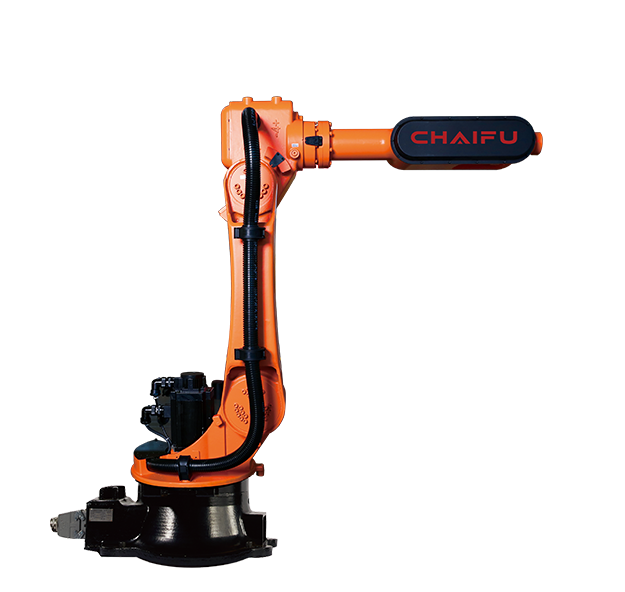
SF10-C1650 | Example robot for compact handling
4. Heavy Workpiece Handling
Moving large metal components and machinery parts requires a suitable payload rating, working range and rigid workholding. CHAIFU ALPHTIC six-axis heavy-duty robots provide a high-payload platform for engineering evaluation in demanding material handling applications.

SF500-C3100 | Heavy-duty material handling robot
5. Palletizing and Stacking
Industrial handling robots can also transfer cartons, bags, containers and building materials onto pallets. Four-axis palletizing robots may be more efficient for repetitive stacking where special part orientation is not needed.
Explore Palletizing RobotsProduct images show CHAIFU robot models. They illustrate suitable robot categories and do not represent commissioned customer production lines.
CHAIFU Industrial Handling Robot Series
Choose the series according to payload, required reach, workpiece orientation and the overall handling task. Actual model suitability requires engineering verification.
CHAIFU SF10-C1650 low-payload six-axis robot · Official product image
6–10 kg rated-payload rangeLOTIC Series
Low-Payload Industrial Robots
Small parts, pick and place, compact machine tending
View LOTIC Robot Series →CHAIFU SF50-C2185 medium-payload robot · Official product image
20–125 kg rated-payload rangeMIMETIC Series
Medium-Payload Handling Robots
Machine tending, workpiece transfer and handling
View MIMETIC Robot Series →
CHAIFU SF210-K2650 high-payload robot · Official product image
210–310 kg rated-payload rangeBIOTIC Series
High-Payload Handling Robots
Larger components, machinery parts and industrial handling
View BIOTIC Robot Series →CHAIFU SF500-C3100 heavy-duty six-axis robot · Official product image
500–6,000 kg rated-payload rangeALPHTIC Series
Heavy-Duty Six-Axis Robots
Large workpieces, heavy machinery and steel component handling
View ALPHTIC Robot Series →Product images are sourced from CHAIFU official series pages. Model selection and final specifications should be confirmed with CHAIFU.
Industrial Handling Robot Specifications
The following figures are an initial model comparison and must be confirmed against the applicable technical datasheets before a quotation.
| CHAIFU Model | Rated Payload | Reach | Potential Application |
|---|---|---|---|
| SF6-C1200 | 6 kg | 1,200 mm | Compact part handling |
| SF10-C1650 | 10 kg | 1,650 mm | Part transfer / pick and place |
| SF20-K1735 | 20 kg | 1,735 mm | Machine tending |
| SF50-C2185 | 50 kg | 2,185 mm | Medium-load parts |
| SF80-C2600 | 80 kg | 2,600 mm | Extended-reach transfer |
| SF120-C2269 | 120 kg | 2,269 mm | Medium-load workpiece handling |
| SF210-K2650 | 210 kg | 2,650 mm | High-payload handling |
| SF500-C3100 | 500 kg | Confirm model datasheet | Heavy machinery component transfer |
| SF800-C2850 | 800 kg | 2,850 mm | Heavy workpiece handling |
| SF1200-C3765 | 1,200 kg | 3,765 mm | Large industrial loads |
Payload refers to the robot wrist rating under specified conditions. The total lifted mass includes the workpiece, gripper and additional tooling. Center of gravity, inertia, motion profile and reach constraints must be checked. Published reach for SF500-C3100 has varied across product materials; confirm its current datasheet.
How to Choose an Industrial Handling Robot
1. Calculate Total Handling Load
Total lifted mass = workpiece + gripper + additional tooling. For example, a 60 kg workpiece, a 15 kg gripper and 5 kg of tooling produce an 80 kg total load. A robot with an 80 kg nominal rating is not automatically suitable: load center, inertia and motion conditions still require verification.
2. Check the Complete Working Envelope
Assess pickup and placement positions, conveyor or machine heights, required orientations, obstacles and safe approach paths—not just the advertised maximum reach.
3. Determine Required Cycle Time
Include approach, gripping, transfer, placement and return in the handling cycle. The achievable rate depends on payload, distances, robot motion, gripper speed and machine interfaces.
4. Choose the Gripping Method
Mechanical, pneumatic, vacuum, magnetic or custom tooling may be appropriate depending on the workpiece. A handling solution must consider geometry, surface conditions and product integrity.
5. Plan Integration and Safety
Review installation space, machine signals, conveyor layout, safeguarding, commissioning and maintenance access before finalizing the robot model.
Discuss Your Handling RequirementsRobotic vs. Manual Material Handling
| Factor | Industrial Handling Robot | Manual Handling |
|---|---|---|
| Repetitive tasks | Programmable, repeatable movements | Operator-dependent |
| Heavy workpieces | Subject to robot and tooling ratings | May require lifting assistance |
| Changeovers | May need new programs or tooling | Can suit irregular, low-volume tasks |
| Initial investment | Robot, fixtures, tooling and integration | May need less equipment investment |
| Operating schedule | Can support extended operation with suitable design | Depends on staffing and work arrangements |
Robotic handling is most valuable when task repetition, part consistency and production volume justify automation. There is no universal solution for every factory.
Why Choose CHAIFU for Industrial Material Handling?
Multiple Payload Classes
Compare low-, medium-, high- and heavy-payload robot platforms for different workpieces.
Flexible Six-Axis Motion
Articulated robots can serve complex part orientations and multi-station movements.
Robot Technology Development
CHAIFU develops industrial robot systems and related motion-control technologies.
Application-Oriented Selection
Robot selection considers tooling, safety, controls, work envelope and process requirements.
Applications include machinery manufacturing, metal fabrication, automotive components, construction equipment, industrial packaging and logistics.
Industrial Handling Robot FAQs
What is an industrial handling robot used for?
It moves, loads, unloads, positions and transfers materials or workpieces in automated manufacturing environments.
What is the difference between a handling robot and a palletizing robot?
A handling robot can perform many types of movement. A palletizing robot is configured specifically for stacking or removing goods on pallets.
How much weight can an industrial handling robot lift?
Payload differs by model. CHAIFU offers platforms spanning compact to extremely heavy-duty applications; actual workpiece mass must account for tooling and operating conditions.
Which robot works for CNC machine loading and unloading?
A six-axis robot is often a suitable candidate, subject to workpiece mass, reach, machine access, orientation and production cycle.
Can it integrate with existing equipment?
Often yes, when mechanical interfaces, control signals, safety requirements and installation space are compatible.
What is the difference between payload and reach?
Payload is allowable wrist load under specified conditions; reach describes the working distance defined by the robot geometry.
How much does an industrial handling robot cost?
Pricing depends on the robot model, tooling, controller, safety equipment, integration scope and commissioning requirements.
What should I send to receive a quotation?
Share material type, part dimensions, part weight, pickup and placement points, required throughput, factory layout and destination country.
Request an Industrial Handling Robot Solution
Tell us your workpiece type, dimensions and weight, pickup and placement positions, cycle-time target, available space and destination country. Our team can review potential robot configurations for your project.
Request a QuotationVisit CHAIFU Global