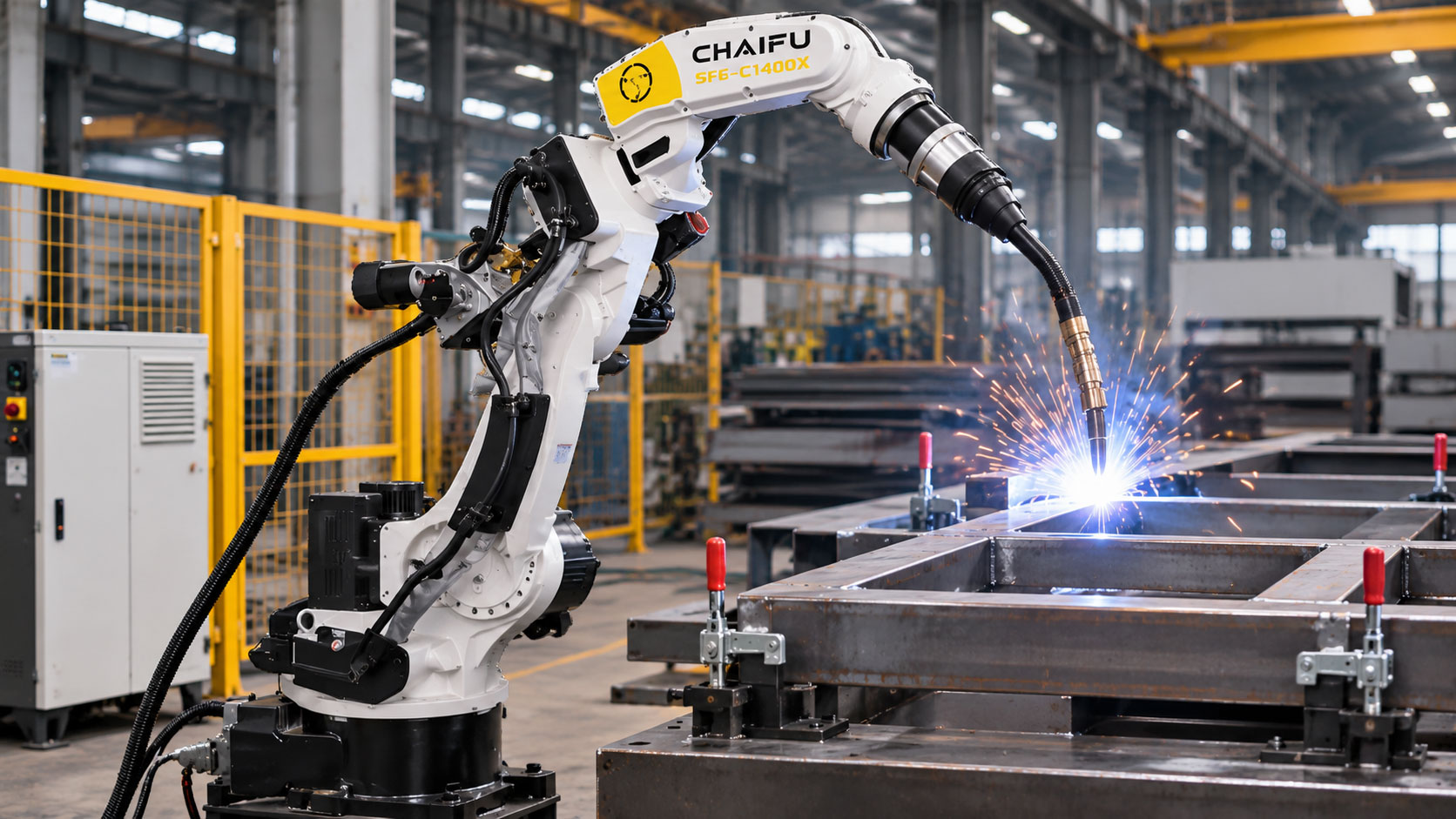







Laser Welding Robot, Cell & System Solutions | CHAIFU

Laser Welding Robot, Robotic Welding Cell & System Solutions
Planning a laser welding robot cell for repeatable metal components? Explore CHAIFU six-axis welding robot arms and the engineering considerations behind an integrated laser welding system—from robot reach and tooling to fixtures, laser safety and production requirements.
Request a Project Quote Explore CHAIFU ARC RobotsRobot platform and complete laser welding cell scope must be confirmed for each project.
What Is a Laser Welding Robot?
A laser welding robot combines a programmable industrial robotic arm with a compatible laser welding head and laser source to guide the beam along a controlled weld path.

Compared with a manually guided process, robotic laser welding can support repeatable tool paths on suitable parts. The achievable weld quality depends on joint fit-up, material, laser parameters, clamping, shielding, motion coordination and process validation—not on robot repeatability alone.
Laser Welding Robot Arm vs. Cell vs. Complete System
Laser Welding Robot Arm
A six-axis arm provides motion and positioning. Select by reach, wrist payload, tooling center of gravity, cable routing and access to weld joints.
Laser Welding Robot Cell
A guarded station may combine a robot, laser source, welding head, fixtures, part loading, interlocks, extraction and coordinated controls.
Laser Welding Robot System
For production-line automation, assess multiple fixtures, indexing, part transfer, monitoring, quality checks and interfaces with upstream and downstream equipment.
CHAIFU Welding Robot Arms to Evaluate
CHAIFU's ARC Series is a published six-axis industrial welding robot range. The official series page identifies welding and laser-related application potential. Whether a particular model is suitable for a laser welding head must be checked against its tooling and system requirements.
ARC6-140-6
6 kg payload · 1,440 mm reach · ±0.05 mm repeatability
A compact option to evaluate for enclosed robotic welding stations and smaller repeatable components.
View Product DetailsARC6-208-6
6 kg payload · 2,008 mm reach · ±0.05 mm repeatability
A longer-reach platform to evaluate for larger workpieces or more widely spaced fixture positions.
View Product DetailsARC10-145-6
10 kg payload · 1,450 mm reach · ±0.08 mm repeatability
An option to evaluate when the combined welding head and wrist tooling require a higher payload rating.
View Product DetailsPublished CHAIFU ARC robot specifications; all three list IP65 protection. Rated robot specifications do not confirm laser-head compatibility, attainable weld quality or complete-cell performance. Refer to the applicable delivered machine datasheet.
| Model | Axes | Payload | Reach | Repeatability | Protection |
|---|---|---|---|---|---|
| ARC6-140-6 | 6 | 6 kg | 1,440 mm | ±0.05 mm | IP65 |
| ARC6-208-6 | 6 | 6 kg | 2,008 mm | ±0.05 mm | IP65 |
| ARC10-145-6 | 6 | 10 kg | 1,450 mm | ±0.08 mm | IP65 |
Where a Robotic Laser Welding System May Be Suitable
Sheet-Metal Enclosures & Housings
Repeatable seams on appropriately designed thin-metal assemblies, subject to joint access and welding trials.
Automotive & Machinery Components
Selected brackets, subassemblies and fabricated parts where repeatable positioning and joint preparation can be maintained.
Stainless-Steel Fabrication
Components requiring controlled heat input, with qualified parameters and suitable shielding for the material and finish.
Multi-Station Metal Manufacturing
Production layouts requiring indexing, part loading or coordinated movement between fixtures, subject to integration engineering.
These are candidate application types, not claims that CHAIFU has delivered a particular laser cell in each industry. Welding feasibility should be validated with representative samples.
What Goes Into an Automatic Laser Welding Robot Cell?
Robot & Welding Head
Match the robot's wrist payload, reach and motion path to the selected laser head and beam-delivery equipment.
Laser Source & Process
Define material, joint geometry, penetration needs, power requirements, shielding and qualified welding parameters.
Fixtures & Positioners
Control component alignment and repeatable joint fit-up; review the need for indexing or additional axes.
Safety & Extraction
Design appropriate enclosed guarding, interlocks, laser-safe viewing, emergency stops and fume extraction.
Controls & Integration
Coordinate robot motion, laser enable signals, safety circuits, production interfaces and operator routines.
Testing & Acceptance
Validate sample welds, inspection criteria, uptime assumptions, maintainability and site-specific compliance.
How to Evaluate Laser Welding Robot Price
There is no meaningful single laser welding robot price without a defined equipment scope. The price of a robot arm is different from the cost of an integrated laser welding robot machine or production cell.
| Cost element | Questions that affect the quote |
|---|---|
| Robot arm | Reach, payload, controller, mounting method and required axes |
| Laser equipment | Laser source, welding head, optics, cooling and monitoring |
| Cell equipment | Enclosure, safety systems, extraction, fixtures and positioners |
| Automation | Conveyors, indexing, sensors, PLC interfaces and traceability |
| Engineering & service | Process trials, programming, integration, commissioning and support location |
To obtain a useful quotation, share workpiece drawings, material and thickness, joint locations, target cycle time, expected production volume, destination country and whether you need a robot only or a complete safeguarded cell.
Frequently Asked Questions
What is the difference between a laser welding robot and an arc welding robot?
Laser welding uses a focused laser beam as the heat source, while arc welding uses an electric arc. The required welding equipment and process parameters differ; robot compatibility must be assessed for the selected method.
Can a CHAIFU ARC robotic arm be used in a laser welding robot cell?
CHAIFU identifies laser-related applications on its ARC Series page. Suitability depends on the laser head's weight, moment, inertia, beam delivery, robot path, controls and system safety design. Confirm the specific model and integration scope before ordering.
Is a laser welding robot machine the same as a complete welding system?
Not always. Some listings refer to the robot arm; others include the laser source and a fully guarded workstation. Request a written bill of equipment and acceptance criteria.
Which robot model should I choose?
Compare the required reach and wrist load, then evaluate access to each weld, fixture clearances and cable routing. CHAIFU ARC6-140-6, ARC6-208-6 and ARC10-145-6 offer different reach and payload combinations.
How much does a laser welding robot system cost?
Price depends on robot model, laser source and welding head, safety enclosure, fixtures, sensors, automation and engineering services. A project-based quote is more useful than a robot-only price for production planning.
Do laser welding cells require special safety measures?
Yes. Industrial laser welding may involve hazardous beam exposure, reflections and process emissions. Safety measures such as engineered guarding, interlocks and extraction should be designed and validated by qualified specialists for the installation.
Request a CHAIFU Laser Welding Automation Assessment
Send your workpiece information and expected production requirements. CHAIFU can help review the applicable robotic arm platform and discuss project-specific integration options and supply scope.
Helpful information: material & thickness · dimensions · joint drawings · takt time · annual volume · required supply scope · destination country.
Email Your Project Requirements See CHAIFU ARC SeriesContact: contact@chaifuglobal.com | Model specifications and integration feasibility are subject to technical confirmation.
2026-11-24