










Heavy Duty Robotic Arms: Complete Guide to High-Payload Industrial Automation
2026-09-09

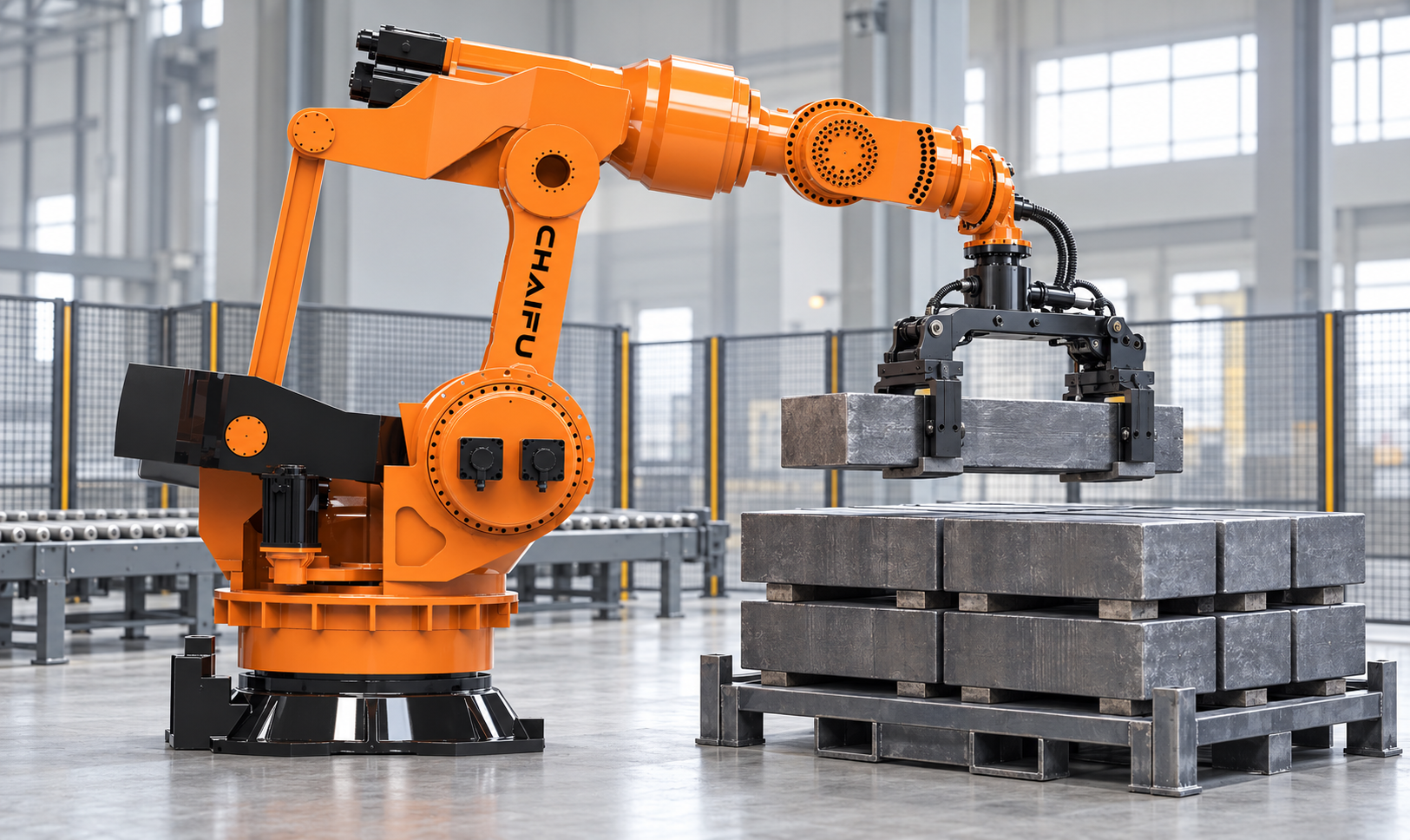
Manual handling of heavy components poses severe health and safety risks, limits production throughput, and drives up operational costs. Implementing a robot arm for heavy lifting—commonly referred to as a high-payload or heavy-duty industrial robot—allows manufacturers to automate demanding material handling tasks with high speed and precise repeatability.
This guide breaks down key operational capabilities, technical selection factors, and ROI considerations for high-payload robotic arms.
What Defines a Heavy Lifting Robot Arm?
In industrial automation, any robotic manipulator designed to handle dynamic loads exceeding 100 kg to 6,000+ kg falls into the heavy-payload category. These systems feature reinforced mechanical structures, high-torque servo motors, and specialized gearboxes engineered to manage extreme inertial forces during high-speed acceleration and braking.
Key Industry Applications
Automotive Manufacturing: Body-in-white transfer, engine block handling, and heavy structural assembly.
Metal & Heavy Fabrication: Loading large steel plates, castings, and forgings into CNC machines.
Palletizing & Logistics: High-speed stacking of heavy crates, bags, and bulk cargo.
Foundry & Stamping Lines: Operating reliably in high-temperature, harsh industrial environments.
4 Technical Criteria for Selecting a Heavy Payload Robot
Choosing the right heavy-duty robot arm requires analyzing more than just maximum weight limits. Overlooking dynamic forces or physical constraints often leads to premature mechanical wear or system failure.
| Selection Factor | Technical Considerations |
| Payload vs. Offset (CG) | Verify the complete payload-moment diagram. The rated capacity includes the weight of both the workpiece and the End-of-Arm Tooling (EOAT) at specific Center of Gravity (CG) distances. |
| Reach & Working Envelope | Ensure full kinematic reach across all pick-and-place stations without forcing axes into joint limits or singular positions. |
| Foundation & Mounting | High-payload movements impose massive dynamic shear and overturning moments on factory floors, frequently requiring reinforced concrete pads (typically 300mm–500mm depth). |
| End-of-Arm Tooling (EOAT) | Match the gripper mechanism—hydraulic clamps, magnetic lifters, or high-vacuum arrays—to the material geometry and duty cycle. |
Traditional Heavy Industrial Robots vs. High-Payload Cobots
Modern automation offers two distinct architectural approaches for heavy lifting:
               +-------------------------------------------+
               |     HEAVY MATERIAL HANDLING SOLUTIONS      |
               +--------------------+----------------------+
                                    |
            +-----------------------+-----------------------+
            |                                               |
            v                                               v
+-----------------------+                       +-----------------------+
|  Heavy Duty Robots    |                       | High-Payload Cobots   |
| (Payload: 200–6,000kg)|                       |  (Payload: 20–50kg)   |
| • Max payload/speed   |                       | • Cage-free safety    |
| • Safety caging req.  |                       | • Small footprint     |
| • Fixed automation    |                       | • Flexible redeploy   |
+-----------------------+                       +-----------------------+
Standard Industrial Robots (e.g., 6-Axis Articulated): Built for maximum speed, reach, and extreme weight capacities (up to 0,000 kg). They require physical safety fencing, light curtains, and dedicated cell spaces.
Heavy-Duty Collaborative Robots (Cobots): Engineered for mid-weight payloads (20 kg to 50+ kg) with integrated force-torque sensors for open-floor operations alongside human teams.
Calculating ROI and Long-Term Efficiency
Investing in heavy lifting automation delivers measurable operational returns across multiple metrics:
Safety & Ergonomics: Minimizes workplace injuries related to heavy manual lifting, lowering workers' compensation and turnover costs.
Cycle Time Consistency: Operates continuously at peak acceleration profiles without fatigue or thermal degradation.
Part Protection: Reduces material damage caused by accidental drops or improper manual handling.



.png)

