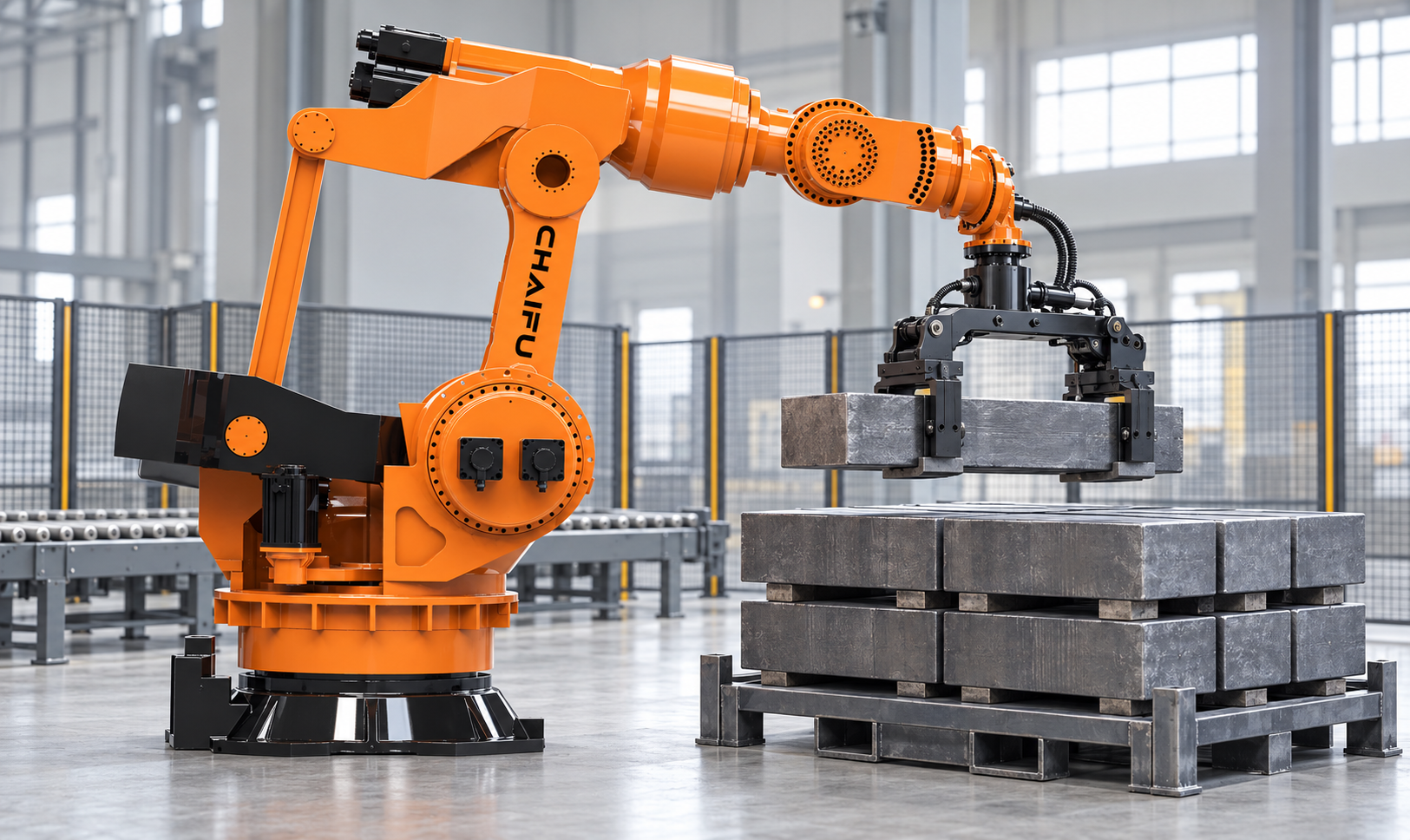
Heavy-Duty Palletizing Robots for Heavy Industrial Loads
2026-10-27

Heavy-duty palletizing robots automate the transfer and stacking of heavy products onto pallets, transport frames or purpose-built supports. These systems are intended for manufacturers handling large metal components, castings, machinery parts or grouped loads, including those operating in heavy industry.
CHAIFU’s ALPHTIC series provides six-axis industrial robots with rated payloads ranging from 500 to 6,000 kg. These robots can be evaluated as the motion platform for heavy-load palletizing cells where component orientation, access angles and handling between processes matter. The robot, gripper and cell layout must be selected together for the application.
To discuss a project, send your product weight, dimensions, stacking requirements and production target to contact@chaifuglobal.com.
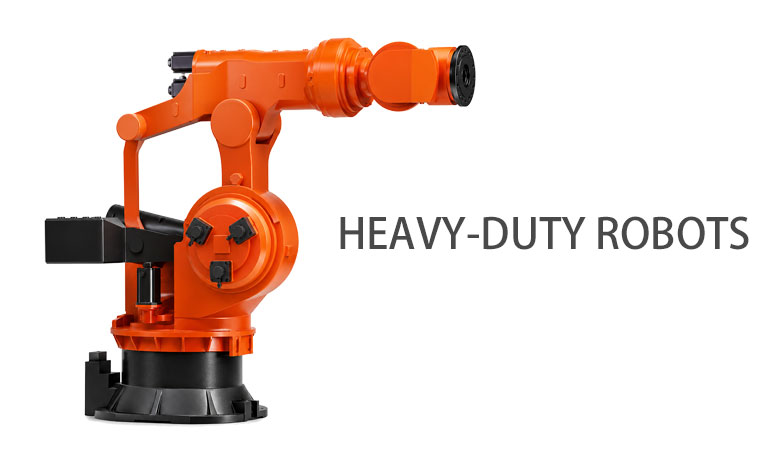
What Is a Heavy-Duty Palletizing Robot?
A heavy-duty palletizing robot is an industrial robot used to arrange substantial loads into a defined stacking pattern. Depending on the application, each movement may transfer one component, several products or a complete layer.
The robot operates within a larger system that presents the load, grips it securely, identifies the destination and manages pallet exchange. A suitable design accounts for the product’s shape, center of gravity, stability and required placement tolerance. For large industrial parts, the destination may be a reinforced stillage or transport fixture rather than a conventional warehouse pallet.
When to Choose a Six-Axis Palletizing Robot
A six-axis robot offers control of both position and orientation. This is useful when a component must be tilted, rotated into a transport fixture or approached from a direction that changes between pickup and placement.
Consider a six-axis heavy-duty robotic arm when the process includes:
Reorienting irregular components before stacking.
Placing parts into racks or fixtures with restricted approach angles.
Combining palletizing with component transfer or machine loading.
Handling product families that require different tool attitudes.
A dedicated four-axis palletizing robot is also worth evaluating when the load can remain level throughout a repetitive stacking cycle. The choice should follow the required motion, cycle time and layout. Additional axes provide orientation flexibility; they do not automatically deliver a faster palletizing cycle.
For a dedicated four-axis option, explore the CHAIFU ALPHTIC PA series.
Representative CHAIFU ALPHTIC Robot Models
The following six-axis models illustrate several payload and reach combinations available within the ALPHTIC range. They are candidates for application assessment; the final choice depends on the tooling, load distribution and complete working cycle.
Model
| Rated Payload | Maximum Radius | Repeatability | |
SF1200-C3765 | 1,200 kg | 3,765 mm | ±0.2 mm |
SF1800-C4600 | 1,800 kg | 4,600 mm | ±0.3 mm |
SF2000-C4000 | 2,000 kg | 4,000 mm | ±0.3 mm |
SF5000-C3700 | 5,000 kg | 3,700 mm | ±0.3 mm |
SF6000-C3285 | 6,000 kg | 3,285 mm | ±0.3 mm |
Specifications reference: CHAIFU ALPHTIC product information. Confirm the current technical specification and allowable loading conditions during selection.
Maximum radius does not define usable stacking height, and robot repeatability alone does not establish the placement accuracy of the finished cell.
Applications for Heavy-Duty Robotic Palletizing
Metal Components and Castings
Heavy castings, fabricated assemblies and machined components can require different pickup and placement orientations. A six-axis arrangement is worth assessing when parts must be aligned with locating features or placed into dedicated transport supports. The engineering review should establish gripping surfaces, load balance and how each component will remain stable after release.
Machinery and Equipment Manufacturing
Large housings, structural parts and subassemblies may need to move from a machining or assembly station into a shipping fixture. Combining transfer and palletizing in one robotic cell can simplify the handling sequence when the layout and production rate support it. Product drawings and fixture geometry help determine whether the required approach paths are achievable.
Building Materials and Grouped Loads
Heavy blocks, slabs and grouped products are possible applications for robotic stacking, subject to product strength and gripper design. Contact pressure, edge protection and support during lifting require attention.
For bags or cartons, compare individual picking with grouped or layer handling before selecting a high-payload robot. A lower-payload dedicated palletizer may fit an individual-package process more closely.
These application examples identify processes to evaluate. Each project needs validation using its actual products, tooling and operating conditions.
How to Select a Heavy-Duty Palletizing Robot
Calculate the Complete Carried Load
Start with the total mass carried by the robot during the heaviest intended pick. Include the products, gripper, adapter and other carried equipment. If a pallet or transport frame is lifted with the products, include its mass as well.
For example, a 420 kg component combined with a 90 kg gripper and a 15 kg adapter creates a 525 kg carried load. On mass alone, this exceeds a robot rated for 500 kg.
This is an illustrative calculation, not a model recommendation: the next selection step is to check the load geometry and dynamic limits.
Check the Load Center and Wrist Limits
Two loads with the same mass can impose different demands on the robot. A long component held away from the mounting flange creates different wrist loading from a compact component held close to it. Review the combined center of gravity, allowable moments and inertia against the manufacturer’s load data.
The assessment must cover the required positions, orientations and motion profile. A payload figure by itself cannot confirm that a particular gripper and workpiece combination is acceptable.
Validate Reach and Stacking Height
Model the actual pickup location, pallet positions, transport fixtures and highest placement point. Account for the gripper length, product dimensions, approach clearance and nearby equipment.
Check both the lowest and highest layers and the farthest placement positions. A robot that reaches an empty pallet may still face restrictions when the stack is full or the tool must withdraw around an adjacent load. The usable work envelope depends on the complete geometry of the cell.
Evaluate the Entire Production Cycle
Define the required output in components, layers or pallets per hour. Then assess gripping, transfer, settling, release and return movements alongside product supply and pallet exchange.
A realistic cycle study includes the intended payload and tooling. It should also consider how the system handles a missing product, a full pallet or a temporary upstream delay. Compare proposed solutions using the same operating assumptions so that quoted performance describes a comparable production task.
Match the Gripper to the Product
Select the gripping method around the product’s surfaces, rigidity and acceptable contact pressure. Mechanical clamping, vacuum, magnetic handling or purpose-built supports may be appropriate for different products. Each approach requires checks for the specific material and load condition.
Validate the grip during motion as well as at pickup. Review product retention, release clearance and the load condition after placement. For deformable packaging or uneven surfaces, tests with representative samples can reveal handling issues that drawings alone may miss.
What a Complete Robotic Palletizing System Should Include
Define the scope of the cell before requesting a quotation. Depending on the application, it may include:
The robot, controller and application tooling.
Product infeed equipment, locating fixtures and pallet stations.
Control interfaces, operating controls and stacking programs.
Sensors or vision where product positions require detection.
Guarding, access controls and protective functions determined by the cell risk assessment.
Installation, commissioning, operator training and maintenance documentation.
Confirm which items are included in the proposal and which are supplied separately. Vision, automatic tool changes and pallet handling should be specified according to the process. The required recovery sequence and operator access also need to be defined before commissioning.
What Affects the Cost of Heavy-Duty Palletizing Automation?
Project cost depends on the robot size and the equipment needed to make the process work. Tooling complexity, the number of pallet positions, product variation, controls integration and site installation requirements can materially change the quotation.
Compare proposals using the same scope and acceptance criteria. Include the target production rate, placement requirements, changeover procedure and support requirements. For large robots, assess foundations, floor loading and access for installation early, because these can influence the overall project design.
Frequently Asked Questions
Can a 500 kg robot palletize a 500 kg product?
The complete carried load must fit the robot’s allowable loading conditions. When a 500 kg product requires additional tooling, a 500 kg rated payload is insufficient on mass alone. Include all carried equipment and check the load center, wrist limits and intended motion before choosing a model.
Does the highest-payload model also have the longest reach?
Payload and reach must be compared separately. The model table shows different combinations, so the heaviest-rated robot should not be assumed to cover the largest work area. Select for the required load and the actual pickup and placement positions together.
Can the same robot palletize and depalletize?
A robotic cell can be designed for both functions when the tooling, product presentation and controls support them. Depalletizing requires reliable knowledge of the load positions. Depending on how consistently products arrive, this may involve fixed locating features, sensors or a vision system.
Can a robot transfer a fully loaded pallet?
This requires assessment of the complete lifted assembly, including the pallet, products and tooling. The pallet or transport frame must be suitable for the lifting method, and the load must remain stable during motion. Rated robot payload alone does not confirm that the transfer is feasible.
Is robot repeatability the same as finished stack accuracy?
Repeatability describes how consistently the robot returns to a taught position under specified conditions. Finished stack accuracy also depends on product variation, gripping consistency, fixture location and tooling behavior. Define and validate the placement tolerance required by the process at the complete-cell level.
Discuss Your Heavy-Duty Palletizing Project with CHAIFU
Provide the following information to start a model and application review:
Product dimensions, mass and drawings or photos.
Products per pick and the proposed gripper or lifting method.
Pallet or transport-frame dimensions, stacking pattern and final height.
Required output and planned operating schedule.
Available layout, pickup positions and installation conditions.
Upstream and downstream equipment that the cell must connect to.
These details help establish the required payload, usable reach and integration scope for your robotic palletizing system.
Email: contact@chaifuglobal.com
View CHAIFU ALPHTIC heavy-duty robot models and specifications.
Related Topics
high payload palletizing robot
6-axis palletizing robot
heavy load palletizing
robotic palletizing system
heavy duty robotic arm
industrial palletizing automation