










Chaifu's 6-Axis Industrial Robots introduction
2026-07-23

What Is a 6-Axis Industrial Robot?
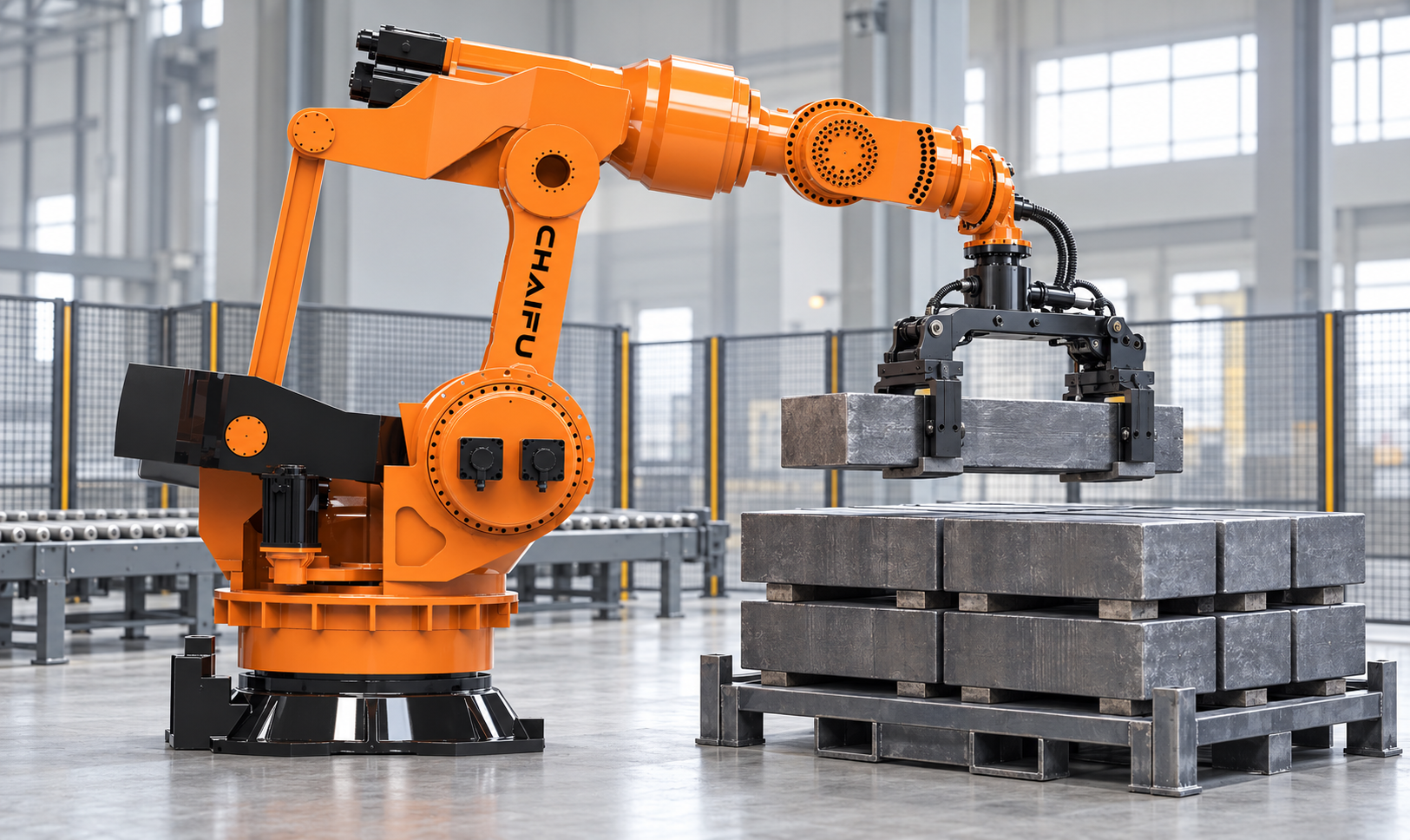
A 6-axis industrial robot, also known as a 6-axis robot arm, robotic manipulator, or articulated industrial robot, is the most widely used type of industrial automation equipment in modern manufacturing. Featuring six independently controlled rotary joints (J1–J6), it replicates the movement of the human shoulder, elbow, and wrist, enabling the end-of-arm tooling (EOAT) to reach virtually any position and orientation within a three-dimensional workspace.
Compared with SCARA robots and Cartesian robots, a 6-axis robotic arm offers unmatched flexibility, allowing it to perform complex motion paths, multi-angle operations, and precision tasks across a wide range of industries.
Today, 6-axis industrial robots are extensively used for robotic welding, palletizing, machine tending, material handling, assembly, polishing, grinding, painting, packaging, and automated inspection, making them the preferred solution for Industry 4.0 and smart manufacturing.

Motion Principle
· J1–J3 control the robot's position in the X, Y, and Z axes.
· J4–J6 independently control the orientation of the end effector, including roll, pitch, and yaw.
This six-degree-of-freedom configuration enables full spatial positioning and orientation, making it the most versatile robot architecture for industrial automation.
Types of 6-Axis Industrial Robots
Traditional 6-Axis Industrial Robots
Traditional articulated robots are designed for high-speed, high-payload, and high-precision manufacturing. They typically operate inside safety fences or guarded work cells.
Key Features
· High speed and productivity
· Heavy payload capacity
· Excellent rigidity
· Outstanding positioning accuracy
· Continuous 24/7 operation
Typical Specifications
· Payload: 7–6,000 kg
· Reach: 759–4,600 mm
· Repeatability: ±0.03 mm to ±1 mm
Typical Applications
· Robotic arc welding
· Spot welding
· Machine tending
· Material handling
· Heavy palletizing
· Automotive manufacturing
Advantages of 6-Axis Industrial Robots
Maximum Flexibility
With six degrees of freedom, a 6-axis robot arm can access confined spaces, avoid obstacles, and perform complex multi-angle operations that are impossible for SCARA or four-axis robots.
Multi-Process Automation
By simply changing the end-of-arm tooling (EOAT), one robot can perform multiple manufacturing processes, including:
· Robotic welding
· Material handling
· Machine tending
· Grinding and polishing
· Spray painting
· Screw fastening
· Pick and place
· Assembly
This versatility significantly improves equipment utilization and production flexibility.
High Precision and Repeatability
Chaifu's industrial robot arms deliver exceptional repeatability of up to ±0.03 mm, ensuring consistent product quality while minimizing human error and production defects.
Wide Payload and Reach Options
Manufacturers offer models ranging from lightweight robots for electronics assembly to heavy-duty robots capable of handling several tons, covering nearly every industrial application.
Continuous 24/7 Production
Unlike manual labor, industrial robots can operate continuously without fatigue, reducing downtime, improving efficiency, and lowering overall manufacturing costs.
How to Choose the Right 6-Axis Industrial Robot
When selecting a 6-axis industrial robot, consider the following key specifications:
Parameter | Description |
Payload Capacity | Maximum weight the robot can safely carry, including the end effector and workpiece. |
Maximum Reach | Maximum distance from the robot base to the tool flange, determining the available workspace. |
Repeatability | The robot's ability to return to the same position repeatedly. Precision assembly typically requires ±0.02 mm or better. |
Protection Rating (IP Rating) | IP54 is suitable for standard factory environments, while IP67 is recommended for wet, dusty, or painting applications. |
Why Choose a 6-Axis Industrial Robot?
A 6-axis industrial robot is the most versatile and widely adopted automation solution in modern manufacturing. Combining high flexibility, exceptional precision, broad payload options, and outstanding process adaptability, it supports virtually every industrial application—from welding and machine tending to palletizing, assembly, inspection, and material handling.
Whether you're building a smart factory, upgrading an automated production line, or improving manufacturing efficiency, a 6-axis robotic arm delivers higher productivity, lower labor costs, consistent product quality, and a faster return on investment.



.png)

