










Introduction to Manipulator-type Material Handling Robots
2026-07-24

Definition
Manipulator-type material handling robots are industrial robots fixed at workstations. Equipped with multi-degree-of-freedom mechanical arms, they complete grabbing, transferring, stacking, loading and unloading of workpieces and materials. They are a core category of material handling robots.
Different from mobile vehicles such as AGVs and AMRs, they operate within a fixed working range and realize short-distance material transportation through arm movements. They are widely applied to fixed-point automated handling on production lines.

2. Main Types and Features
(1) 6-axis articulated handling manipulators
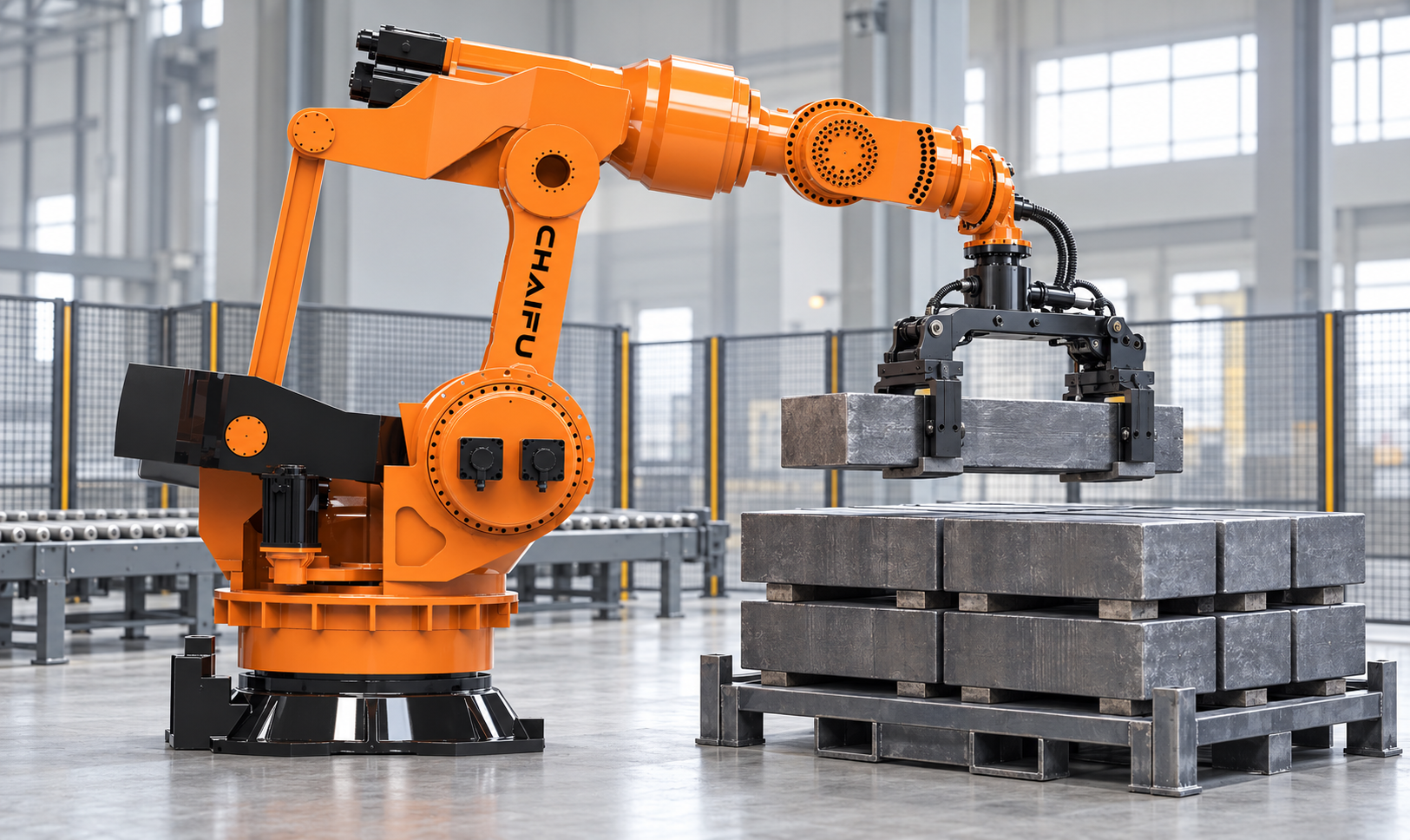
The most versatile model with six rotary joints, delivering flexible movement and multi-angle material grabbing.
Load capacity: 0.5kg to 6000kg, suitable for both tiny lightweight parts and heavy workpieces.
Applications: CNC machine loading and unloading, component transferring, finished product palletizing and box handling.
Advantages: Small floor space, high motion freedom and the ability to avoid equipment interference.
Chaifu's industrial robots load capacity ranges from 7 kg to 6,000 kg, covering a full lineup including desktop robots, multi-joint robots and heavy-duty robots to meet the demands of diverse manufacturing scenarios.In welding and laser processing sectors, Chaff has built a mature robot application platform featuring high-precision trajectory control, high dynamic response and stable continuous operation. It delivers consistent processing quality while drastically boosting production efficiency and economic benefits.
(2) Gantry handling robots (portal manipulators)
Adopting a gantry rail structure, they move linearly along X, Y and Z axes with long strokes and ultra-large load capacity.
Advantages: Ultra-high positioning accuracy, capable of loading and unloading multiple machine tools simultaneously, and supporting heavy loads up to several tons.
Applications: Metal plates, large castings, barreled raw materials and heavy-duty machine tool assembly line handling.
(3) Collaborative handling manipulators
No safety fences required. Built-in force sensors allow close collaborative operation with human workers.
Features: Automatic shutdown upon collision, high safety, lightweight and easy installation.
Scenarios: Small-part sorting, light workpiece transferring and auxiliary manual handling stations.
3. Core Components
1.Manipulator body: Metal joints, servo motors and reducers to realize arm extension and rotation.
2.End effector (gripper): Vacuum suction cups for cartons and plates, pneumatic clamps for metal parts, flexible grippers for special-shaped materials, responsible for grabbing materials.
3.Perception system: 3D vision cameras and force sensors identify disorderly stacked materials, adjust grabbing force and prevent material collision damage.
4.Control cabinet: Robot control system that presets handling trajectories and grabbing sequences.
5.Auxiliary tooling: Material positioning jigs, material racks and safety fences (standard for conventional industrial manipulators).
4. Core Functions
1.Machine tool loading and unloading: Automatically grab blanks and feed them into processing equipment, then take out finished workpieces after machining, replacing manual repetitive feeding.
2.Palletizing & depalletizing: Neatly stack finished cartons and bags onto pallets, or disassemble stacked goods.
3.Workstation material transfer: Deliver components between adjacent processes on assembly lines.
4.Material sorting and tray loading: Grab disorderly materials and neatly place them on material trays.
5. Advantages
1.Stable and high efficiency: Round-the-clock non-stop repetitive operation with unified handling cycle for stable production capacity.
2.High precision and low wastage: Repetitive positioning accuracy up to ±0.03mm, reducing workpiece collision and scrappage.
3.Reduced labor costs: Replace labor-intensive repetitive handling posts and cut recruitment and management expenses.
4.Adaptable to harsh working conditions: Operate in workshops with high temperature, dust, oil stains and mild corrosiveness to protect workers.
5.Easy production line integration: Connect seamlessly with MES and PLC production line control systems to form fully automated assembly lines.
6. Application Industries
1.Machining: Automated loading and unloading for lathes and machining centers.
2.Grain & oil, chemical industry, building materials: Palletizing and handling of packaging bags and barreled raw materials.
3.3C electronics: Sorting and transferring of PCB boards and plastic small parts (collaborative manipulators are mostly adopted).
4.Food & beverage: Palletizing of whole cases of drinks and food cartons.
5.Automotive manufacturing: Fixed-point transferring of stamping parts and engine components.



.png)

