









Loading and Unloading Robots: Smart Automation for Modern Manufacturing
2026-07-22

I. Definition
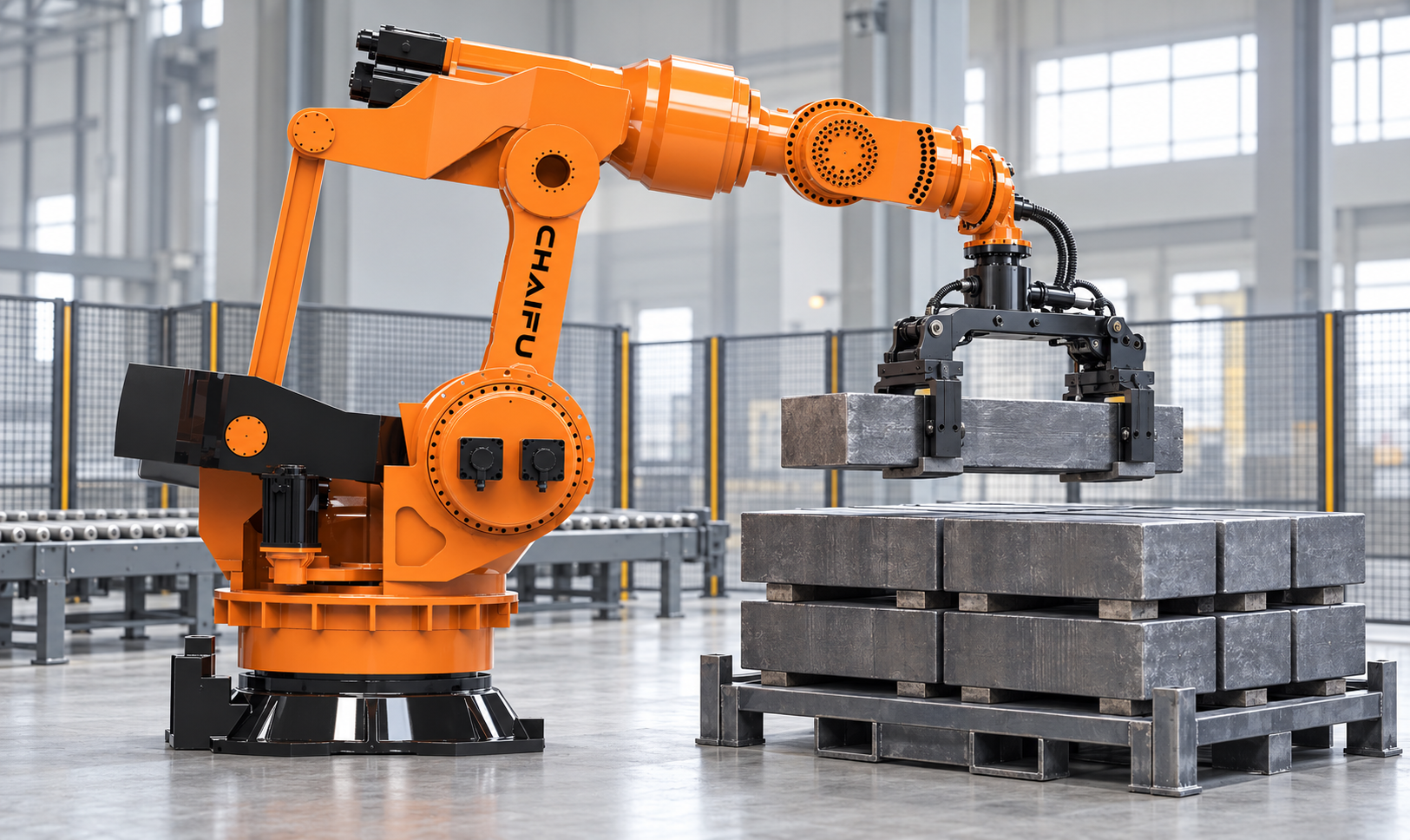
Loading and unloading robots are integrated automated systems designed for industrial automation scenarios. With industrial robots as their core execution units, they integrate end-effector, material feeding and storage, control, sensing, and safety devices to automatically perform workpiece loading, unloading, transfer, and orientation adjustment.
Loading: Precisely picks up raw materials and semi-finished products from storage locations such as hoppers, pallets, and conveyor lines, and positions them at processing or workstations on equipment such as CNC machine tools, stamping presses, injection molding machines, inspection stations, and assembly lines.
Unloading: Removes finished or semi-finished products from processing or inspection stations and transfers them to designated areas such as finished goods conveyor lines, hoppers, pallets, or packaging stations.

II. Core Functions and Value
Production Automation: Replaces manual labor in repetitive, physically demanding, and high-risk loading and unloading tasks to achieve continuous and stable operation.
Efficiency Improvement: Consistent cycle times and 24-hour continuous operation significantly improve equipment utilization rates and overall production capacity.
Consistent Quality: High repeatability and positioning accuracy eliminate manual clamping errors, bumps, and scratches, improving product consistency and yield rates.
Cost Reduction and Efficiency Gains: Reduces the number of frontline operators, lowering labor costs and the risk of workplace injuries, while adapting to harsh operating conditions such as high temperatures, high pressure, dust, and high noise levels.
Flexible Adaptability: Rapidly switches between workpieces through programming and gripper changes to meet the demands of flexible production involving multiple product varieties and small batches.
Digital Integration: Supports integration with systems such as PLCs, CNCs, and MES to enable data collection, process monitoring, and production traceability.
III. System Composition
Robot Body
Articulated Robots: Primarily 4-axis or 6-axis models, offering high flexibility and a large working envelope, suitable for complex layouts and multi-robot coordination.
Cartesian / Gantry Robots: Featuring high rigidity, high payload capacity, precise positioning, and cost-effectiveness, they are suitable for long-stroke applications, heavy-duty workpieces, and linear handling of machine tool rows.
SCARA Robots: Capable of high-speed, precise movement in two dimensions, they are used for rapid pick-and-place and assembly of small, precision parts.
End-Effectors: Customized according to workpiece characteristics, including pneumatic grippers, electric grippers, vacuum cups, electromagnetic chucks, and specialized fixtures.
Control System: Robot controller + teach pendant, responsible for motion planning, logic control, and coordination with peripheral equipment.
Feeding/Storage Units: Hoppers, towers, vibratory feeders, pallet stacks, conveyor lines, etc., ensuring continuous material supply.
Discharge/Transfer Units: Conveyor lines, bins, pallets, packaging stations, etc., for collecting and transferring finished products.
Safety Protection System: Safety fences, safety light curtains, safety door locks, and emergency stop circuits, compliant with ISO 10218 and GB 11291 safety requirements.
Sensors and Detection: Vision positioning, force sensors, photoelectric/proximity switches, enabling precise gripping, posture correction, and in-position detection.
Equipment Interface: I/O hardwiring, Profinet, Ethernet/IP, Modbus, and other bus systems, enabling coordinated control of machine tool doors, fixtures, and machining start/stop operations.
IV. Typical Application Scenarios
Metal Cutting: Automatic loading and unloading for CNC lathes, milling machines, machining centers, and grinders
Stamping / Forging: Sheet metal feeding, high-temperature handling of forgings
Injection Molding /Die Casting: Automatic part retrieval and transfer for plastic and die-cast components
Heat Treatment: Automated handling of workpieces before and after furnace processing
Inspection and Assembly: Automatic loading and unloading for CMMs, vision inspection, and assembly stations
Packaging and Palletizing: Placing finished products into boxes and palletizing (including core loading and unloading operations)
V. Key Selection Criteria
Workpiece: Dimensions, weight, material, surface condition, gripping method
Equipment: Model, interfaces, workspace, cycle time requirements
Performance: Repeatability, motion speed, load capacity
Layout: Workshop space, equipment arrangement, mounting configuration (floor-mounted / inverted / side-mounted)
Flexibility: Changeover frequency, ease of programming and gripper replacement
Cost: Robot body, tooling, integration, O&M, and spare parts availability
Standards: Safety compliance, performance specifications, communication protocol compatibility



.png)

