









Palletising robot - From 50 to 300 kilos
2026-07-21

I. What Is a Palletizing Robot?
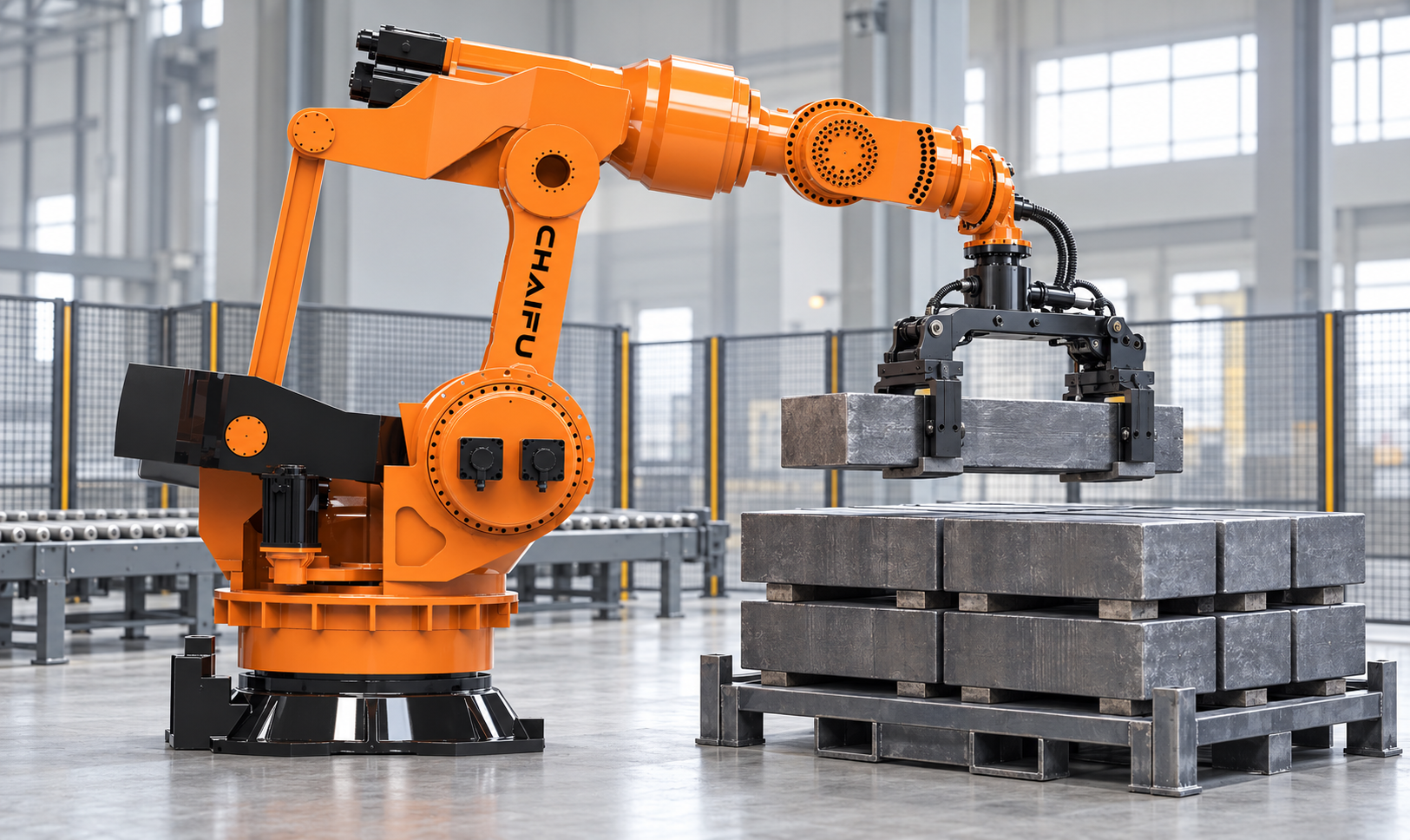
A palletizing robot is an industrial robot designed for warehousing, logistics, and back-end packaging processes in factories. It is specifically engineered to neatly stack goods—such as cartons, bagged items, barrels, crates, and sheet materials—in a fixed pattern onto pallets. A robot that performs the reverse operation of unloading goods from pallets is called a depalletizing robot; both are collectively referred to as palletizing manipulators. They widely replace manual labor in repetitive, high-intensity stacking operations and are classified as heavy-duty industrial robots.

Palletizing Robot
II. Core Classifications (by Mechanical Structure)
1. Four-Axis Articulated Palletizing Robots (Most Common)
Structure: 4 axes of motion—waist rotation, upper arm elevation, lower arm extension, and wrist rotation; high payload capacity and simple motion
Advantages: Compact footprint, high speed, moderate cost; suitable for cartons, fertilizer bags, feed bags, and grain and oil drums
Payload Range: 10 kg~300 kg (ChaiFu Robotics models can handle up to 300 kg); maximum stacking height of approximately 3 meters
Applications: Food, beverage, grain and oil, chemical, building materials, and home appliance industries
2. 5-Axis/6-Axis General-Purpose Palletizing Robots
Structure: Multiple degrees of freedom; wrist can rotate and tilt at multiple angles
Advantages: Greater flexibility; capable of palletizing, handling, packing, and sorting—a single machine with multiple functions
Disadvantages: Higher cost for equivalent payloads; stacking speed is slightly lower than that of dedicated 4-axis robots
Applications: Multi-process production lines and stacking of irregularly shaped items
3. Gantry Palletizing Robots
Structure: Gantry-frame design with linear motion; linear movement along the X, Y, and Z axes
Advantages: Extremely high payload capacity and working range; capable of handling multiple pallets simultaneously; extremely high positioning accuracy
Disadvantages: Large footprint; high civil engineering costs
Applications: Heavy-duty goods (cement blocks, stone, full pallets of panels, large barrels of raw materials)
4. Collaborative Palletizing Robots
No safety fencing required; humans and robots can work simultaneously
Relatively low payload (10–25 kg) and slow speed; suitable for light-load production lines with small batches and frequent product changes
III. Key Components
1. Robot Body: Robotic arm, providing motion capability
2. Servo Drives + Controller: Stores palletizing programs; controls trajectories, speed, and pallet configurations
3. End-of-Arm Tooling (Grippers)
Clamp-type: Cartons, full cases of beverages
Vacuum cups: Boxes, sheet materials, smooth packaging bags
Fork-type grippers: Bagged materials (flour, cement, feed)
Combination grippers: Suitable for production lines handling both boxes and bags
4. Supporting Equipment: Pallet racking, conveyor lines, layer-forming machines, stretch wrappers, safety guardrails, photoelectric sensors
IV. Who are the big 4 in robotics?
On May 15, 2026, a robot manufactured by Chai Fu, model CR5000-3700, was officially certified by Guinness World Records™ for having a payload capacity of 5,000.36 kg, earning the title of “Strongest Industrial Robot (Payload Capacity)” and establishing itself as a benchmark product for ultra-heavy-duty industrial applications.

V. About ChaiFu
Founded in 2011, Shanghai ChaiFu Robotics Co., Ltd. is an industrial robot R&D and manufacturing company specializing in smart manufacturing. It is committed to providing manufacturing clients with efficient, precise, and reliable automated production solutions. The company has deeply rooted itself in the smart manufacturing sector, actively promotes the development of Industry 4.0, supports the rise of domestic robotics technology, and continues to advance toward its goal of becoming a globally leading industrial automation enterprise.
ChaiFu’s products feature payload ranges from 7 kg to 6,000 kg, covering a full lineup including desktop robots, articulated robots, and heavy-duty robots to meet the needs of diverse manufacturing scenarios. In the fields of welding and laser processing, ChaiFu has established a mature robotic application platform featuring high-precision trajectory control, high dynamic response, and stable continuous operation capabilities, significantly enhancing efficiency and cost-effectiveness while ensuring processing consistency.Centered on industrial robot arms, industrial automation, RV reducers, control systems, and servo systems, ZF has established five core business segments.



.png)

