









What is industrial robotic arms?
2026-07-15

Industrial robot arms are programmable, multi-degree-of-freedom, automatically controlled actuators that mimic human hands to perform repetitive, high-precision industrial tasks such as gripping, welding, assembly, material handling, and polishing. They are the core equipment of automated production lines.
I. Four Core Components of a Complete System
1. Mechanical Body (Skeleton)
Base: A fixed mounting base, available in floor-mounted, inverted, and wall-mounted configurations; heavy-duty models feature a reinforced base
Linkage + Joints: Joints determine the degrees of freedom (number of axes), categorized as rotary joints and linear joints; the core transmission components are RV reducers (for large joints) and harmonic reducers (for the wrist), which directly determine precision
End-Effector (Manipulator): The “hand” of the robotic arm, which can be quickly swapped out: pneumatic/electric grippers, vacuum suction cups, welding torches, grinding heads, dispensing valves, screwdriver bits, etc. Structural Breakdown of an Axial Robotic Arm

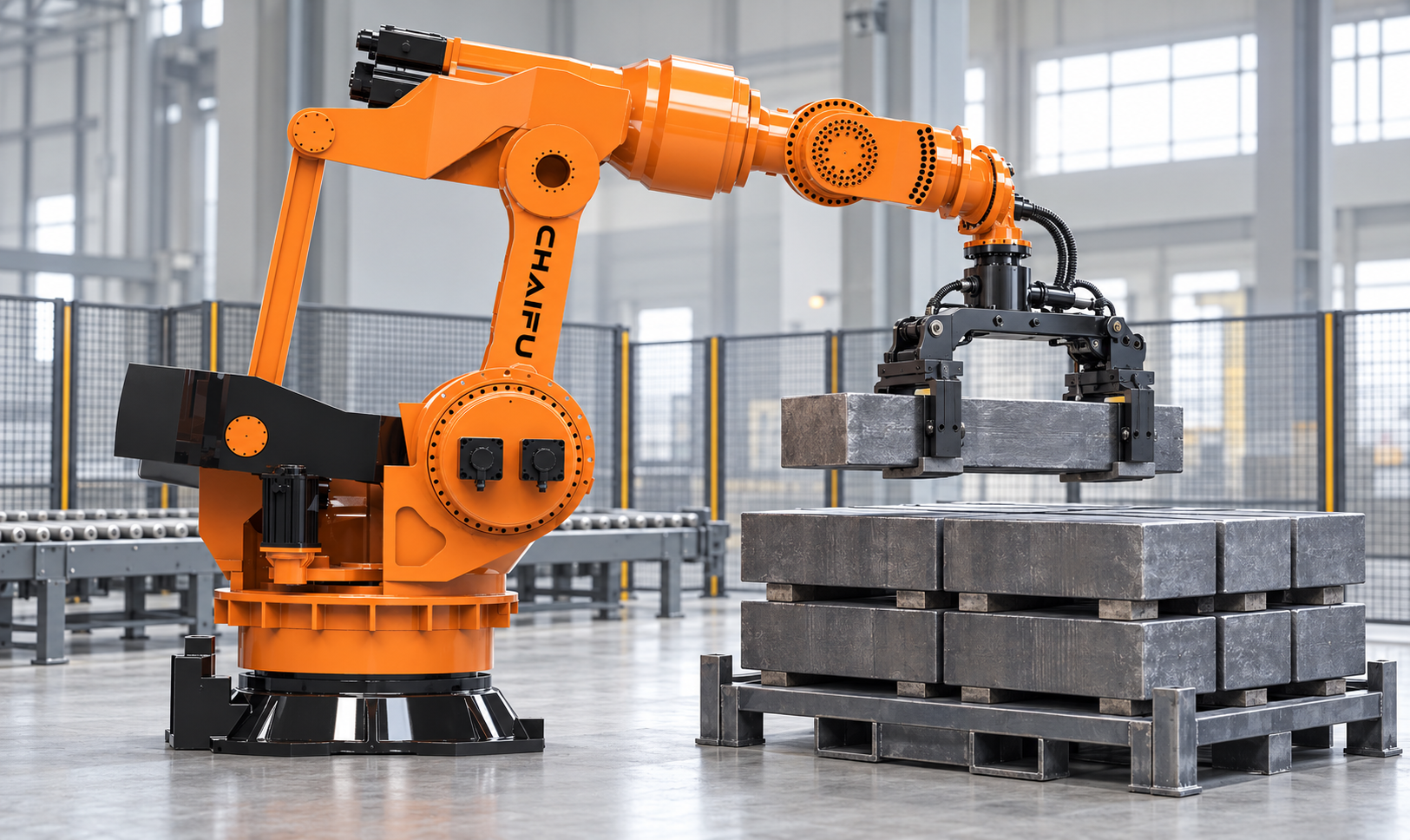
Industrial Robots(Heavy duty robot)
2. Drive System (Power)
Servo motor drive (mainstream, over 90%): Accuracy ±0.01–±0.05 mm, fast response, load capacity 1 kg–1 metric ton, suitable for the vast majority of applications
Pneumatic drive: Low cost, high speed, suitable for handling light loads and small parts; average precision
Hydraulic drive: Extremely high load capacity (500 kg or more), used for stamping and heavy-duty casting; prone to oil leaks
3. Control System (Brain)
Controller + teach pendant, supporting three programming methods:
Teach-in programming: Manually drag to record a trajectory (most commonly used for on-site debugging)
Offline programming: Computer simulation modeling and program import; suitable for complex welding and painting
Vision-linked programming: Paired with 2D/3D cameras for random part picking and vision-based positioning
4. Sensing Modules (Eyes/Touch)
Vision cameras: Workpiece recognition, positioning, quality inspection, and random sorting
Force sensors: Grinding, assembly, and collision prevention in human-robot collaboration
Encoders, limit switches, temperature sensors, and collision detection sensors
As one of the few domestic companies with R&D and production capabilities across the entire industrial robot value chain, ChaiFu has deep expertise in core technologies and is among the few companies capable of competing with international brands across its full range of RV reducers. At the 2025 China International Industry Fair, the company unveiled the world’s first heavy-duty industrial robot with a wrist-rated payload exceeding 5 metric tons, setting a new industry record. On May 15, 2026, the CR5000-3700 model was officially certified by Guinness World Records™, earning the title of “Strongest Industrial Robot (Load Capacity)” with a load capacity of 5,000.36 kg, establishing itself as a benchmark product for ultra-heavy-duty industrial applications. Centered on industrial robot bodies, industrial automation, RV reducers, control systems, and servo systems, ZF has established five core business segments.
II. Five Major Types of Robotic Arms (Classified by Structure)
1. Six-axis articulated robotic arm (general-purpose, accounts for the largest market share)
Structure: 6 rotational joints (3 axes for positioning + 3 axes for orientation), modeled after the human arm; 7-axis models offer additional obstacle-avoidance capabilities
Advantages: Spherical workspace, freely adjustable posture, ability to navigate around obstacles; payload range of 0.5 kg to 6,000 kg (achievable by ChaiFu Robotics), reach of 0.5–4 m
Accuracy: Repeatability of approximately ±0.02 mm
Applications: Automotive welding, painting, and material handling; metal grinding; home appliance assembly; machine tool loading and unloading
2. SCARA 4-Axis Horizontal Articulated Arm (Specialized for 3C Electronics)
Structure: 2 horizontal rotation axes + Z-axis lift + wrist rotation axis, totaling 4 axes
Advantages: High-speed movement in the XY plane, extremely high vertical rigidity along the Z-axis, compact footprint
Applications: PCB component insertion, screw fastening, mobile phone component assembly, dispensing, lithium-ion battery sorting
3. Delta Parallel-Link Robot (The King of High-Speed Pick-and-Place)
Structure: Three sets of parallel linkages fixed at the top, with parallel drive to the end effector
Advantages: Extremely fast, 100–300 picks per minute, light payload
Applications: Food packaging, pharmaceutical sorting, snack box packing, high-speed placement of small electronic components
4. Cartesian/Gantry Robots (Gantry Linear Type)
Gantry Cartesian Robots
Structure: X/Y/Z three-axis linear guide motion
Advantages: Can achieve very long travel, heavy-duty, simple structure, low cost, extremely stable positioning
Applications: Loading and unloading of large machine tools, part retrieval from injection molding machines, palletizing in automated warehouses, handling of large 3C components
5. Collaborative Robots (Human-Robot Collaboration, Safe and Fence-Free)
Structure: Typically lightweight 6- or 7-axis designs with built-in force-controlled collision detection
Key Features: Immediately stops upon contact with a person; no safety fencing required; can operate alongside humans at the same workstation
Applications: Small-batch, high-variety assembly; laboratories; packaging; flexible production lines
III. Key Parameters for Selection
Payload: Maximum weight the end-effector can grasp (must allow for a 20% margin, including the gripper's own weight)
Maximum Reach: The farthest distance the end-effector can extend, determining the working range
Repeatability: ±0.01–0.03 mm for precision assembly; ±0.05–0.1 mm is sufficient for welding/handling
Degrees of Freedom (Number of Axes)
3 axis: Cartesian/Delta, for simple translational motion only
4 axis: SCARA, for planar operations
6 axis: General-purpose, capable of any angular orientation
7 axis: Obstacle avoidance in confined spaces
IP Rating: Select IP65 for workshop environments with dust or water mist; explosion-proof models are available for spray painting applications
IV. Major Application Industries
Automotive Manufacturing: Spot welding, arc welding, body painting, chassis handling, and parts assembly (Primary Applications for 6-Axis Robots)
3C Electronics: SCARA assembly, high-speed Delta sorting, flexible assembly with collaborative robots
Metal Processing: Machine tool loading/unloading, grinding and polishing, stamping part retrieval
Food and Pharmaceuticals: Delta sorting, aseptic packaging, pharmaceutical filling
Logistics and Warehousing: Gantry/6-axis palletizing, carton handling
New Energy: Lithium-ion battery assembly, photovoltaic module handling, charging station welding
As one of China's leading providers of automated smart manufacturing solutions, ChaiFu's system solutions span electronics manufacturing, metal processing, machinery manufacturing, logistics, construction, mining, energy storage, and arts and crafts. The company offers end-to-end delivery ranging from standalone units to fully automated production lines, helping enterprises improve efficiency, reduce costs, and optimize quality.
ChaiFu's products have a payload range from 7 kg to 6,000 kg, covering a full lineup including desktop robots, articulated robots, and heavy-duty robots to meet the needs of diverse manufacturing scenarios. In the fields of welding and laser processing, ChaiFu has developed a mature robotic application platform featuring high-precision trajectory control, high dynamic response, and stable continuous operation capabilities, significantly improving efficiency and cost-effectiveness while ensuring processing consistency.



.png)

