







CHAIFU | AUTOMOTIVE COMPONENT MANUFACTURING
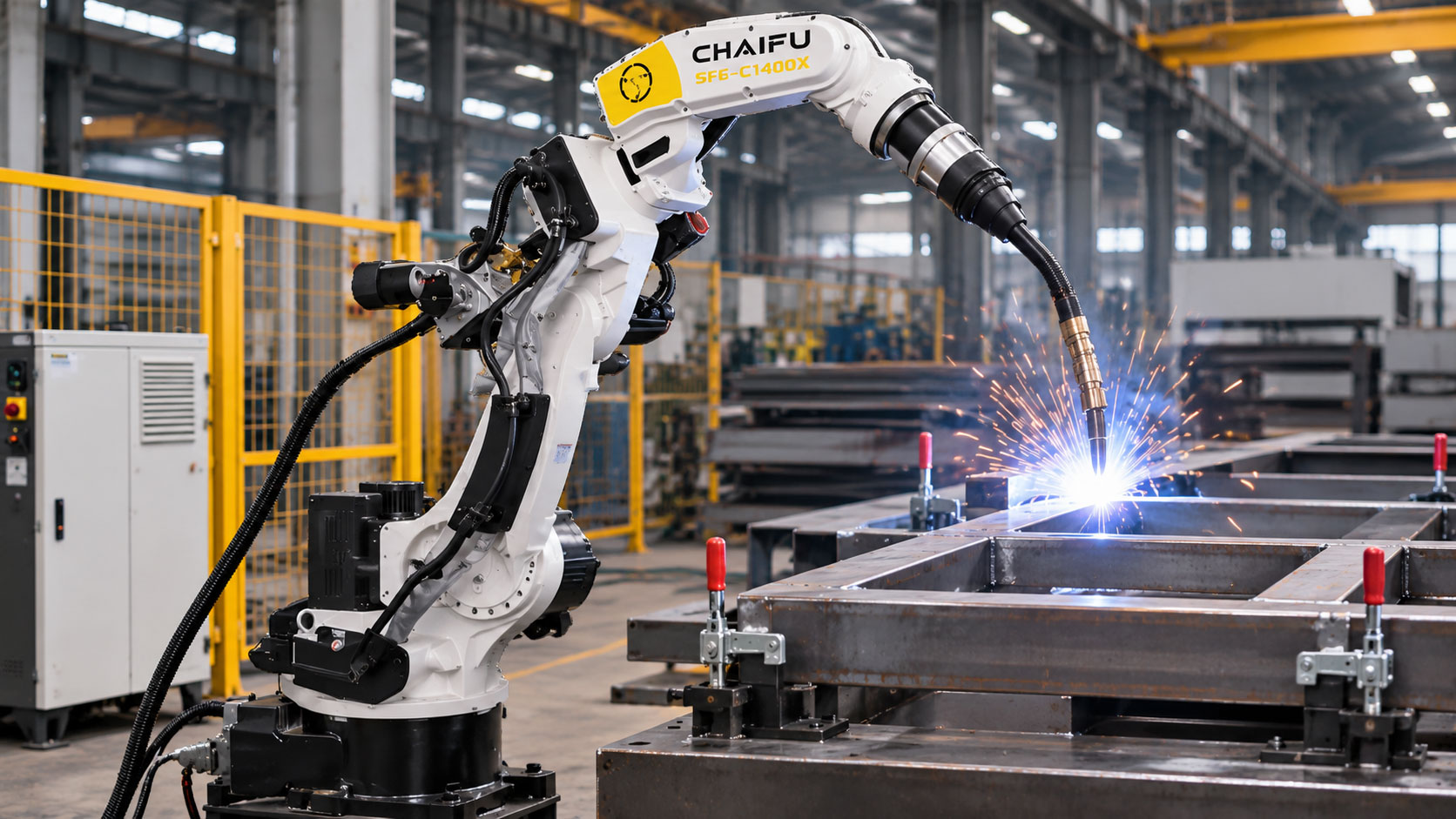
Automotive Parts Robotic Welding
Repeatable robot paths for fabricated automotive metal components.
A Practical Approach to Automotive Parts Robotic Welding
Automotive suppliers often weld recurring part families under demanding requirements for joint access, repeatability and production traceability. A suitable robotic welding system should be selected around the actual component, weld specification and quality process rather than simply choosing the fastest arm.
CHAIFU ARC Series six-axis industrial robots offer published models with 6–10 kg payload, up to 2008 mm reach, repeatability as low as ±0.05 mm and IP65 protection. These are robot specifications; the performance of a complete welding system depends on welding equipment, fixtures, programming and process validation.

Common Welding Applications and Cell Configurations
Select the relevant production scenario before deciding on a workcell layout.
Brackets and mounts
Small and medium fabricated brackets may benefit from controlled fixtures and repeatable torch positioning.
Seats and frame subassemblies
Multi-joint metal assemblies require adequate robot access and stable part location through the weld sequence.
Exhaust and tubular components
Tube geometry can require dedicated clamping, tool clearance analysis and, in some cases, part rotation.
Equipment and vehicle subframes
Larger assemblies may require extended reach, multiple weld positions or coordinated fixtures.
Engineering Checklist Before Requesting a Quote
Accurate application information helps avoid under-sized reach, inaccessible welds and unsuitable fixtures.
| Joint and material | Provide material grade and thickness, joint type, weld access and approved process. |
|---|---|
| Quality plan | Define inspection method, allowable distortion and required production records. |
| Fixture repeatability | Control datum location, clamp repeatability and access for welding and maintenance. |
| Production takt | Evaluate loading, welding, cooling, unloading and rework time as one complete cycle. |
CHAIFU ARC Welding Robot Options
Published ARC Series data provide a starting point; the final choice requires a reach and collision study with the welding torch and related equipment.
| Robot model | Payload | Reach | Repeatability |
|---|---|---|---|
| ARC6-140-6 | 6 kg | 1440 mm | ±0.05 mm |
| ARC6-208-6 | 6 kg | 2008 mm | ±0.05 mm |
| ARC10-145-6 | 10 kg | 1450 mm | ±0.08 mm |
Source: CHAIFU ARC Series product page. Robot specifications are not guarantees of weld quality, cell throughput or process compatibility. Actual delivered configuration governs.
How a Welding Automation Project Is Evaluated
1. Define the workpiece
Send representative drawings, material, weld location, tolerance and annual volume.
2. Check the process
Confirm applicable welding process, qualified procedures and equipment requirements.
3. Review cell concept
Assess robot reach, fixture design, operator access, safety and integration interfaces.
4. Validate and quote
Agree on sample trials where appropriate, acceptance criteria, delivery scope and local support arrangements.
Frequently Asked Questions
Can one welding robot handle multiple automotive parts?
Often a robot can be reprogrammed, but each part family may require different fixtures, tooling access and validated welding parameters.
Does robot repeatability guarantee weld quality?
No. Part fit-up, process stability, welding parameters, fixturing and inspection also determine the result.
Which robot should we choose?
Selection depends on the work envelope, torch and dress package, payload, access and cell cycle requirements.