





What are the main components of a robotic palletizer?
2019-03-28

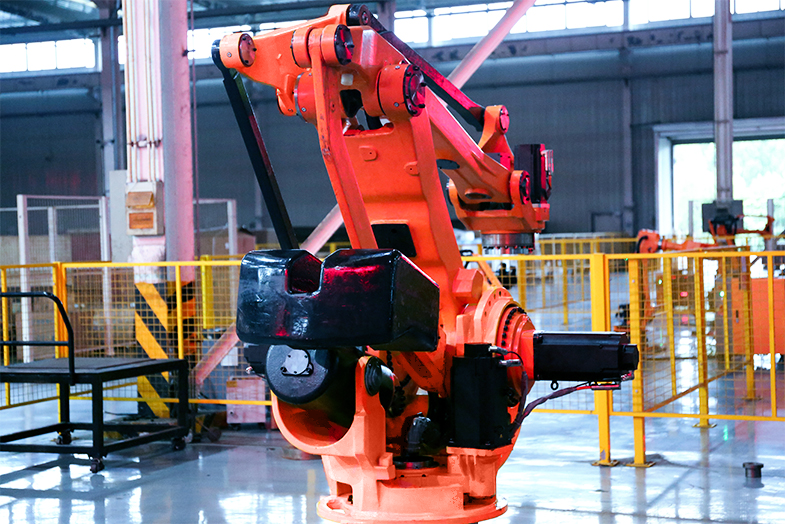
Robotic palletizers are high-tech products that integrate electrical and mechanical systems, and medium- and low-height palletizing robots can meet the needs of medium- and low-volume production. They can also palletize various products—such as bags, rubber blocks, and boxes—according to specified grouping patterns and layer counts. The system primarily consists of a mechanical frame, a servo drive system, an arm mechanism, an end-effector, an end-effector adjustment mechanism, and a detection mechanism. Parameters can be configured based on different material packaging and stacking sequences to perform palletizing operations for various types of packaged materials. Functionally, it is divided into mechanisms for bag feeding, orientation, bag alignment, grouping, bag gripping and palletizing, pallet storage, pallet conveying, and the corresponding control system.
Robotic Palletizer
(1) Bag Feeding Mechanism. A belt conveyor is used to supply bags to the palletizer.
(2) Orientation Mechanism. This mechanism orients and arranges the bags according to a preset program.
(3) Bag Discharge Mechanism. A belt conveyor is used to transport the arranged bags to the bag accumulation mechanism.
(4) Bag Accumulation Mechanism. A belt conveyor is used to consolidate the arranged bags.
(5) Bag Gripping and Palletizing Mechanism. A robotic palletizing system is used to perform the palletizing operation.
(6) Pallet Storage System. Stacked pallets are delivered by forklifts and, according to the program, are individually placed onto the pallet roller conveyor, which systematically supplies empty pallets to the palletizing process. Once a stack of pallets reaches 8 layers, it is transported by the roller conveyor to the stacked pallet storage area, and finally retrieved by a forklift and sent to the warehouse for storage. The system is controlled by a programmable logic controller (PLC).