










6-Axis Robots vs. SCARA Robots: Which One Is Right for Your Production Line?
2026-09-04

Deep dive into degrees of freedom (DoF), structural mechanics, positional repeatability ±0.005mm vs±0.02mm, and dynamic speed variations. Provides a clear procurement selection matrix based on cycle time requirements and 3D spatial reach.
1. Introduction
Selecting the right robot architecture is one of the most critical decisions during factory automation planning. The two most prominent robot types in industrial manufacturing are 6-axis articulated robots and SCARA (Selective Compliance Assembly Robot Arm) robots. While both offer exceptional accuracy and reliability, their motion capabilities, structural mechanics, and ideal use cases differ significantly.
2. Structural and Kinematic Comparison
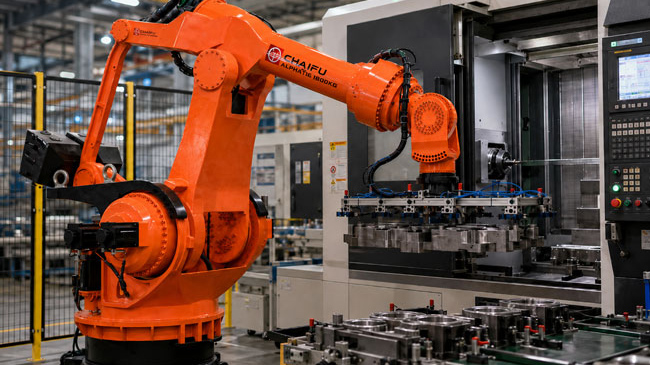
A 6-axis robot features six rotary joints giving it full 3D spatial orientation capabilities (X, Y, Z coordinates plus Roll,Pitch, Yaw). This allows the tool flange to approach workpieces from virtually any angle in a spherical working
envelope. In contrast, a SCARA robot operates on a cylindrical coordinate system, featuring two parallel rotary joints for movement in the X-Y plane and a single linear axis (Z-axis) for vertical motion, along with a rotational axis at thwrist (theta). SCARA arms are exceptionally rigid along the Z-axis while maintaining compliance in the X-Y plane.
Metric / Feature 6-Axis Articulated Robot SCARA Robot
Degrees of Freedom (DoF) 6 (Full 3D orientation) 3 or 4 (Planar + Z translation)
Working Envelope Spherical / Full spatial reach Cylindrical / Pancake footprint
Cycle Speed Moderate to High Ultra-Fast (High PPM)
Repeatability ±0.02 mm to ±0.08 mm ±0.005 mm to ±0.015 mm
Payload Range 3 kg to 1,000+ kg 1 kg to 50 kg
Capital Cost Higher initial investment Lower cost per unit
3. Key Decision Factors for Procurement
3.1 Required Motion Complexity
If your application requires workpieces to be tilted, turned, or approached along complex curved contours (e.g., 3D welding, sealant dispensing on curved automotive windshields, 5-axis equivalent milling), a 6-axis robot is essential.
3.2 Speed and Cycle Time Requirements
For high-volume, repetitive planar pick-and-place tasks—such as semiconductor wafer handling, PCB surface-mount component placement, or small parts packaging—the compact kinematic link of a SCARA robot delivers faster cycle times and superior repeatability.
4. Conclusion & Selection Rule of Thumb
Selection Matrix:
Choose SCARA if: Your task is flat/vertical (top-down), requires high speed (<1 sec cycle), has high precision tolerances, and payload is under 20kg.
Choose 6-Axis if: You need multi-angle orientation, heavy payload lifting, wall/ceiling mounting, or path-following in 3D space.



.png)


