









Industrial Heavy Duty Robots | High-Payload 6-Axis Robots
2026-10-08

Industrial Heavy Duty Robots: High-Payload Automation for Demanding Manufacturing
Industrial heavy duty robots are designed for manufacturing applications where standard industrial robots cannot provide enough payload, reach, rigidity, or working envelope. From handling multi-ton components to palletizing heavy materials, loading large machines, and automating demanding production processes, high-payload robotic systems help manufacturers improve productivity, consistency, and workplace safety.
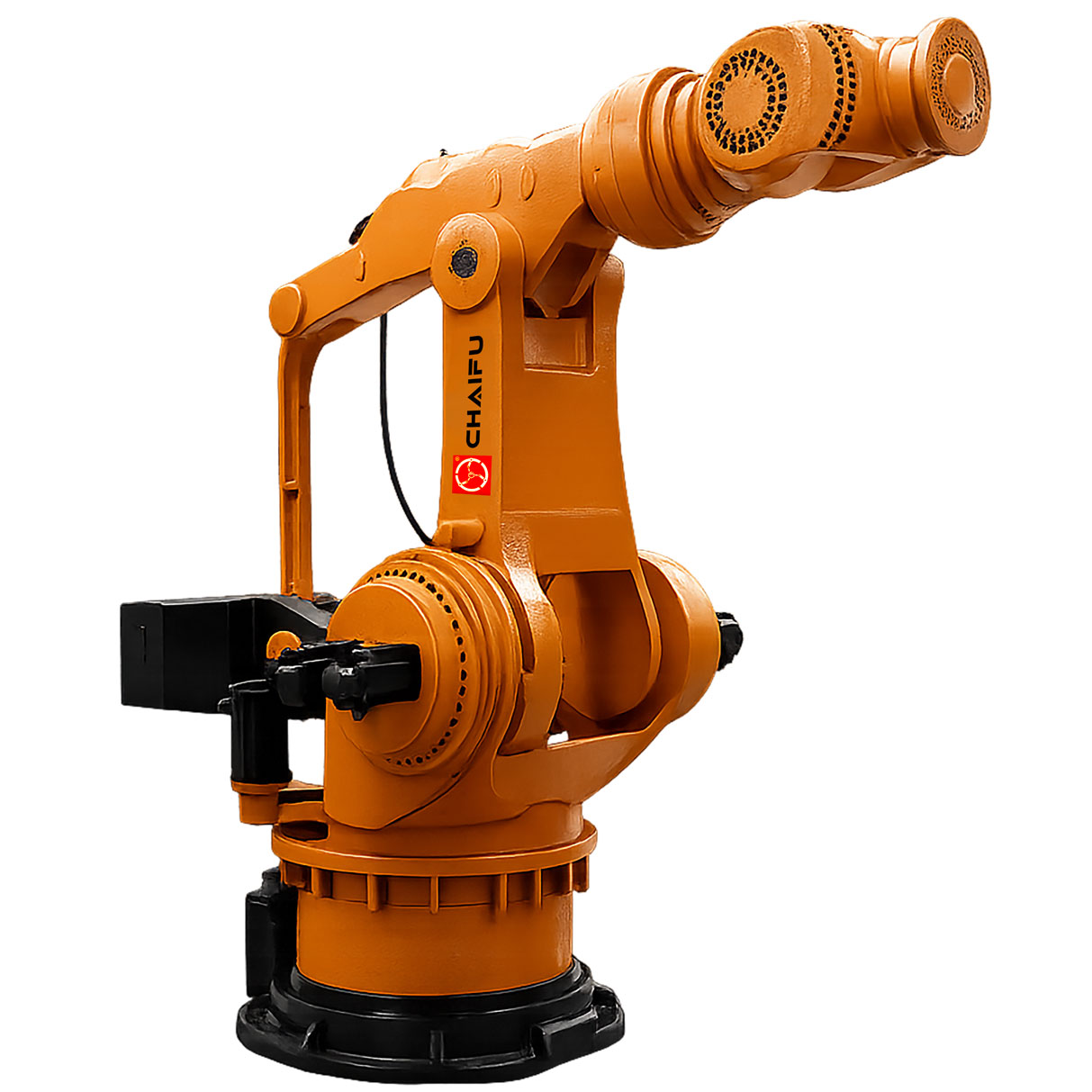
CHAIFU develops six-axis industrial heavy duty robots for high-load automation, with the ALPHTIC Series covering payload capacities from 500 kg to 6,000 kg and working reach of up to 4,600 mm. The series combines high payload capacity, long reach, articulated six-axis motion, industrial protection, and application-oriented automation capabilities.
If your production line requires a robot arm capable of handling hundreds or thousands of kilograms, this guide explains what to look for when selecting an industrial heavy duty robot and how CHAIFU's high-payload robot platform can be applied to demanding industrial environments.
What Is an Industrial Heavy Duty Robot?
An industrial heavy duty robot is a high-payload robotic manipulator engineered to move, position, load, unload, assemble, palletize, or process heavy workpieces and materials.
Compared with conventional industrial robot arms, heavy-duty robots typically require:
Higher payload capacity
Higher structural rigidity
High-torque servo motors
Heavy-duty gear reducers
Larger working envelopes
Higher allowable inertia and moment
Robust mechanical construction
Reliable operation under demanding industrial conditions
Application-specific end-of-arm tooling
Heavy duty industrial robots are commonly used in industries such as metal fabrication, machinery manufacturing, construction materials, automotive manufacturing, logistics, steel processing, foundries, and other heavy manufacturing environments.
The key point is that a heavy-duty robot is not simply a standard robot with a larger payload rating. Payload, center of gravity, reach, inertia, acceleration, tooling weight, cycle time, and installation conditions must all be considered during robot selection.
Why Manufacturers Are Choosing Heavy Duty Industrial Robots
Heavy components have traditionally been moved using cranes, forklifts, manual labor, or dedicated mechanical handling equipment. These methods can work, but they may limit production flexibility and repeatability.
Industrial heavy duty robots offer another approach.
1. Automate Heavy Material Handling
A high-payload robot can repeatedly pick and position heavy workpieces according to a programmed motion sequence.
Typical applications include:
Large metal components
Steel products
Machinery parts
Heavy castings
Construction materials
Industrial containers
Large fixtures
Heavy pallets
Oversized workpieces
2. Improve Repeatability
Heavy industrial automation requires consistent positioning. CHAIFU's ALPHTIC Series lists repeatability specifications ranging from approximately ±0.1 mm to ±0.32 mm depending on the model.
This makes robot selection about more than payload alone. Manufacturers should evaluate the relationship between payload, reach, motion profile, tooling, and required positioning accuracy.
3. Reduce Heavy Manual Handling
Automating repetitive heavy lifting can reduce workers' exposure to strenuous material handling tasks and allow operators to focus on machine supervision, quality control, maintenance, and higher-value activities.
4. Create Flexible Production Cells
A six-axis articulated robot can perform multiple movements within one working envelope.
Depending on the application, the same robot platform can support:
Material handling
Machine loading and unloading
Palletizing
Assembly
Stamping automation
Picking and packing
Spraying
Glazing
Gluing
Custom handling applications
Heavy Duty Robot vs. Standard Industrial Robot
The correct robot depends on the application rather than simply the maximum possible payload.
| Factor | Standard Industrial Robot | Industrial Heavy Duty Robot |
|---|---|---|
| Payload | Low to medium | Hundreds to thousands of kg |
| Workpiece | Small/medium components | Large or heavy components |
| Reach | Moderate | Long-reach options |
| Structure | Standard industrial construction | Reinforced heavy-duty structure |
| Tooling | Standard EOAT | Large/custom heavy-duty tooling |
| Application | General automation | Heavy handling and demanding processes |
| Cell design | Often standardized | Usually application-specific |
| Engineering | Basic application matching | Payload, inertia, CG and reach analysis |
For a relatively light workpiece, a conventional industrial robot may be the better choice.
For applications involving hundreds or thousands of kilograms, a dedicated high-payload industrial robot provides a more appropriate mechanical platform.
How to Choose an Industrial Heavy Duty Robot
Choosing a heavy-duty robot should start with the application rather than the robot catalog.
1. Calculate the Complete Payload
The robot does not only carry the workpiece.
A basic payload calculation is:
Required Payload = Workpiece Weight + Gripper Weight + Tooling Weight + Engineering Margin
For example:
Workpiece: 800 kg
Gripper: 120 kg
Tooling: 80 kg
Total carried load:
1,000 kg
The selected robot must then be evaluated against the actual center of gravity, inertia, wrist load, motion profile, and safety requirements.
Never select a robot only because its advertised payload is higher than the workpiece weight.
2. Evaluate Robot Reach
Reach determines whether the robot can access every required position within the production cell.
Consider:
Pickup position
Drop-off position
Pallet dimensions
Machine location
Conveyor position
Maximum stacking height
Fixture location
Robot base position
Required clearance
A longer reach can provide greater flexibility when designing large automation cells.
CHAIFU's ALPHTIC Series includes models with working reach of up to 4,600 mm.
3. Check Center of Gravity and Inertia
For heavy payload applications, payload capacity alone is not enough.
A 1,000 kg compact workpiece and a 1,000 kg oversized workpiece can create very different mechanical loads.
Engineers should evaluate:
Payload
Center of gravity
Allowable moment
Allowable inertia
Wrist loading
Acceleration
Deceleration
Robot posture
Cycle time
This is particularly important when using large grippers or extended tooling.
4. Consider Cycle Time
Maximum robot speed does not automatically equal high production efficiency.
Actual cycle time depends on:
Workpiece weight
Pick distance
Placement distance
Robot acceleration
Pallet pattern
Product orientation
Gripper operation
Safety restrictions
Required positioning accuracy
A properly sized heavy-duty robot can provide a better balance between payload, speed, accuracy, and service life.
Six-Axis Heavy Duty Robots: Why Six Axes Matter
A six-axis industrial robot provides more motion flexibility than a simple vertical lifting mechanism or four-axis palletizing robot.
The additional axes allow the robot to:
Rotate large workpieces
Change workpiece orientation
Reach around fixtures
Access different sides of a component
Load machines from different directions
Handle irregular workpieces
Perform complex material handling paths
Combine handling with other industrial processes
For large and irregular components, six-axis flexibility can simplify cell design and reduce the need for additional mechanical positioning systems.
CHAIFU's ALPHTIC Series uses a vertically articulated six-axis structure across its high-payload range.
Industrial Heavy Duty Robot Applications
Heavy Material Handling
Heavy-duty robot arms can automate repetitive movement of large components between production stations.
Typical applications include:
Steel component handling
Machinery component transfer
Large casting handling
Fixture loading
Workpiece positioning
Production-line transfer
Machine Loading and Unloading
High-payload robots can load and unload large industrial machines where conventional robot arms cannot provide sufficient capacity or reach.
Applications may include:
CNC machine tending
Press loading
Forging equipment
Casting equipment
Large machining centers
Industrial production equipment
Heavy-Duty Palletizing
Heavy-duty palletizing robots are designed for applications involving products that exceed the practical capacity of conventional palletizing robots.
Potential products include:
Heavy bags
Building materials
Steel products
Machinery components
Large containers
Industrial packaging
Heavy pallets
The robot must be selected based on the combined weight of the product, gripper and tooling rather than product weight alone.
Metal and Steel Manufacturing
Heavy industrial robots can automate repetitive handling of:
Steel components
Metal castings
Forged parts
Large fabricated structures
Heavy tooling
Industrial fixtures
Construction and Engineering
Large robotic arms can support material handling and automation tasks associated with:
Construction components
Structural materials
Heavy panels
Large prefabricated parts
Engineering machinery
Spraying and Surface Processing
Depending on robot configuration and tooling, heavy-duty articulated robots can also be integrated into:
Spraying
Sanding
Glazing
Gluing
Surface treatment
CHAIFU lists these application categories for its ALPHTIC heavy-duty robot platform.
CHAIFU ALPHTIC Industrial Heavy Duty Robots
CHAIFU's ALPHTIC Series is a high-payload six-axis industrial robot platform designed for demanding automation applications.
The current product family covers a wide range of payload requirements:
| Model | Payload | Approx. Reach |
|---|---|---|
| SF500-C3100 | 500 kg | 3,100+ mm |
| SF800-C2850 | 800 kg | 2,850 mm |
| SF1200-C3765 | 1,200 kg | 3,765 mm |
| SF1500-C3870 | 1,500 kg | 3,870 mm |
| SF1800-C4600 | 1,800 kg | 4,600 mm |
| SF2000-C4000 | 2,000 kg | 4,000 mm |
| SF2400-C3760 | 2,400 kg | 3,760 mm |
| SF3000-C3760 | 3,000 kg | 3,760 mm |
| SF4000-C4200 | 4,000 kg | 4,200 mm |
| SF5000-C3700 | 5,000 kg | 3,700 mm |
| SF6000-C3285 | 6,000 kg | 3,285 mm |
Specifications are based on CHAIFU's published ALPHTIC product information; actual machine configuration and delivery specifications should be confirmed for each project.
Key Features of CHAIFU Heavy Duty Robots
500–6,000 kg Payload Range
The broad payload range allows system integrators and manufacturers to select a robot according to the actual application rather than forcing every project into one oversized robot platform.
Up to 4,600 mm Reach
Long-reach models can support large working areas and complex production layouts.
Six-Axis Articulated Structure
Six-axis motion provides flexibility for handling, positioning, machine loading, palletizing, and other complex industrial tasks.
High Industrial Protection
Many ALPHTIC configurations use IP65 protection on the base axes and IP67 protection on the wrist axes, depending on the model.
RV Reducer Technology
CHAIFU states that ALPHTIC robots use LIKEPRECISION technology and RV reducers for their robot joint systems.
Intelligent Automation Support
The platform can be integrated with technologies such as:
Vision tracking
Force sensing
Intelligent programming
Autonomous learning functions
Application-specific software
This allows the heavy-duty robot to become part of a larger automated production system rather than functioning only as a standalone robot arm.
Industrial Heavy Duty Robot Selection Checklist
Before requesting a quotation, prepare the following information:
Workpiece
Product weight
Product dimensions
Center of gravity
Material
Required orientation
Robot
Required payload
Required reach
Required repeatability
Required number of axes
Installation position
Tooling
Gripper weight
Tool dimensions
Center of gravity
Required gripping method
Pneumatic/electric/hydraulic requirements
Production
Cycle time
Working hours per day
Number of shifts
Required throughput
Product variation
Factory Environment
Temperature
Humidity
Dust
Water
Oil
Welding sparks
Hazardous-area requirements
Providing this information allows the robot manufacturer or system integrator to recommend a more appropriate configuration.
Industrial Heavy Duty Robots and ROI
The business value of heavy-duty robot automation should not be evaluated only by the robot purchase price.
A complete evaluation should consider:
Robot investment + tooling + integration + installation + maintenance
against:
Labor savings + productivity + quality improvement + reduced material damage + improved workplace safety + production flexibility
For repetitive heavy material handling, automation can provide consistent movement and predictable production performance.
The most important question is therefore not:
“How much does a heavy-duty robot cost?”
but:
“How much value can the complete robotic system generate over its operating life?”
Why Choose CHAIFU as a Heavy Duty Robot Manufacturer?
For high-payload automation, the robot itself is only one part of the project.
CHAIFU focuses on combining:
Robot Hardware + Core Components + Software + Application Engineering
This approach supports applications requiring:
High payload
Long reach
Six-axis flexibility
Industrial protection
Heavy-duty handling
Machine loading
Palletizing
Customized automation
The ALPHTIC Series provides a scalable platform from 500 kg to 6,000 kg, allowing manufacturers and system integrators to select different robot capacities according to their production requirements.
Frequently Asked Questions About Industrial Heavy Duty Robots
What is an industrial heavy duty robot?
An industrial heavy duty robot is a high-payload industrial robot designed to handle heavy workpieces, materials, machinery components, or industrial products that exceed the practical capacity of conventional robot arms.
What is the difference between a heavy-duty robot and a high-payload robot?
The terms are often used interchangeably. In practice, a heavy-duty industrial robot generally refers to a robot designed not only for higher payloads but also for the structural rigidity, reach, inertia, tooling and operating conditions associated with heavy industrial applications.
How much weight can an industrial heavy duty robot lift?
Payload depends on the robot model and application configuration. CHAIFU's ALPHTIC Series covers payloads from 500 kg to 6,000 kg.
What is the maximum reach of CHAIFU heavy-duty robots?
The ALPHTIC Series includes models with reach of up to approximately 4,600 mm.
Are six-axis robots suitable for heavy material handling?
Yes. Six-axis articulated robots provide flexible positioning and orientation control, making them suitable for heavy material handling, machine loading, palletizing and other complex automation tasks.
Can heavy-duty robots be used for palletizing?
Yes. High-payload robots can be used for heavy-duty palletizing when the complete payload, tooling, reach, center of gravity, inertia and cycle-time requirements are properly evaluated.
What information should I provide when requesting a heavy-duty robot?
The most useful information includes workpiece weight and dimensions, tooling weight, required reach, center of gravity, cycle time, pallet or machine layout, operating environment and required robot motion.
Looking for an Industrial Heavy Duty Robot?
If your application involves 500 kg, 1,000 kg, 2,000 kg, 3,000 kg or more, CHAIFU can help you evaluate the appropriate high-payload robot configuration.
Provide:
Payload + Workpiece Size + Reach + Tooling Weight + Cycle Time + Application
Our engineering team can recommend a suitable heavy-duty robot model and automation configuration.
Request a Heavy Duty Robot Solution
Email: contact@chaifuglobal.com
Explore the CHAIFU ALPHTIC Series Heavy-Duty Robot for detailed specifications, models, payload options and working ranges.




.png)
.png)
